Soil/Plant Water Potential Meter WP4C
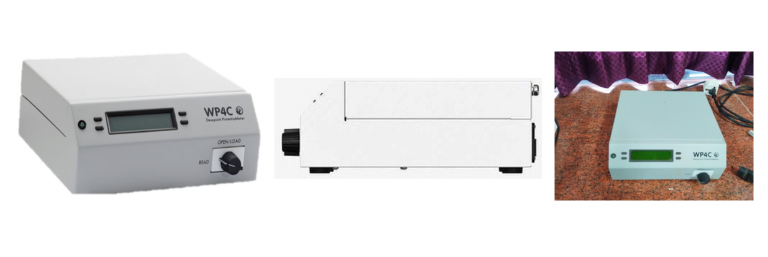
The WP4C Soil/Plant Water-Potential Meter from METER Group is a high-precision laboratory instrument designed to measure total water potential (matric + osmotic) in soils, soilless substrates, plant tissues and other porous materials. It uses the chilled-mirror dew-point method, where a small sealed chamber equilibrates with the sample’s vapor, and a finely-controlled mirror is cooled until dew forms. Both the mirror and sample temperature are measured to determine the sample’s water potential with exceptional accuracy.
With a wide measurement range from ~0 to -300 MPa, this instrument is ideal for research labs in agriculture, soil physics, environmental monitoring and geotechnical engineering. It dramatically speeds up water-potential measurement (5-20 minutes depending on mode), compared to older techniques.
Key Feature
- • Uses chilled-mirror dew-point sensor for direct measurement of water potential, not just correlated proxies.
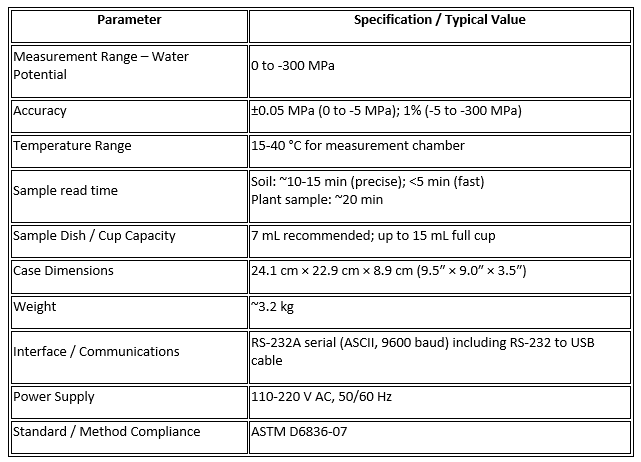
- • Wide measurement range: from just below 0 MPa (-0.1 MPa) to approximately -300 MPa, covering very dry to moderately moist materials.
- • High accuracy: ±0.05 MPa for the range 0 to -5 MPa; 1% for -5 to -300 MPa.
- • Fast equilibration modes: Precise mode (≈10-15 min for typical soil) and Fast mode (<5 min) for quicker measurement when full accuracy is less critical.
- • Durable sample chamber coated in nickel-Teflon for faster equilibrium and easier cleaning.
- • Compatible with standard lab setups: RS-232/USB interface, sample cups from ~7 mL up to ~15 mL capacity.
- • Meets ASTM D6836 standard for measurement method.
Technical Specification
Application / Usage Areas
- • Soil physics & agronomy labs: measurement of soil water potential for irrigation scheduling, understanding plant-available water, field-capacity and wilting-point studies.
- • Plant physiology research: water potential of leaves, stems and seeds—important for plant-water relations, drought stress studies and seed priming.
- • Environmental and substrate research: water potential in soilless media, compost, peat, bricks or other porous materials.
- • Geotechnical & civil engineering: measurement of matric suction in unsaturated soils, slopes or earth-works where negative pore pressures matter.
- • Curriculum and training: educational labs where measurement of fundamental water-potential concepts is required.
Benifits / User Advantages
- • Direct, accurate measurement of water potential rather than relying on proxies—makes results more robust and reliable.
- • Wide range covers extremely dry to moderately moist states—useful for a variety of materials and research goals.
- • Faster than older methods (pressure plates, etc.)—saves time and boosts throughput in labs.
- • Compatible with data logging and automated analysis workflows—reduces manual work.
- • Single instrument for both soil and plant samples—versatile investment.
- • Trusted standard in many research publications—adds credibility to your lab/website offerings.
Best Practice & Considerations
- • While the range starts at ~0 MPa, measurements in the wet-end (above ~-0.1 MPa) become less accurate—be cautious when working near field-capacity.
- • Equilibration time matters: soil samples may need ~10-15 min in precise mode, and plant samples ~20 min. Ensure full equilibrium for best accuracy.
- • Use recommended sample dish sizes (7 mL or up to 15 mL) and ensure good sample preparation (no large air gaps, uniform sample) to avoid errors.
- • Clean the sample chamber regularly; the hydrophobic coating and cleanliness affect equilibrium rates.
- • Maintain stable temperature range (15-40 °C) for measurements; thermal disturbances affect dew-point accuracy.
- • Connect to a data logger or computer for continuous mode if you want automated reading or monitoring over time.



 CALL US
 WHATSAPP
 LOCATION