Integrated Advanced Lysimeter
The Integrated Advanced Lysimeter is a state of the art soil water and water balance monitoring system designed for agricultural research, hydrology, climate science and environmental engineering. This fully integrated station accurately measures the volumetric changes in a defined soil monolith or vessel—encompassing evapotranspiration, drainage/leachate, precipitation, soil moisture, and temperature. By isolating a soil column and combining weighing systems, sensors and data logging, the Lysimeter provides reliable insights into the “invisible” water fluxes within the root zone and soil profile.
Using stainless steel vessel construction (grade 304 or equivalent), precision load cells, embedded moisture and temperature probes, and optional suction/pressure plates for controlled drainage, the device enables high resolution soil water balance measurement. The system captures both the mass change (via weighing) and sensor data (soil moisture, temperature, suction) to deduce percolation, drainage, and evapotranspiration with professional accuracy.
Key Features / Highlights
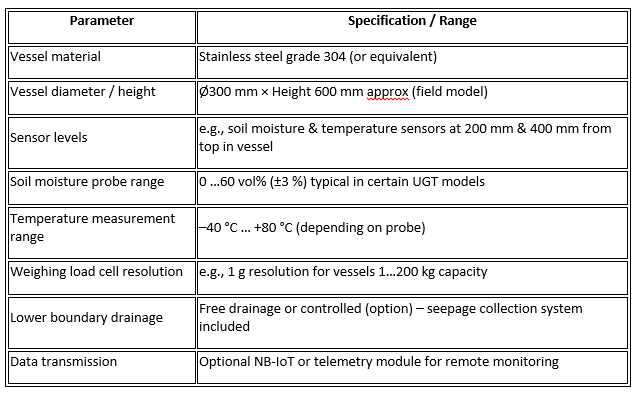
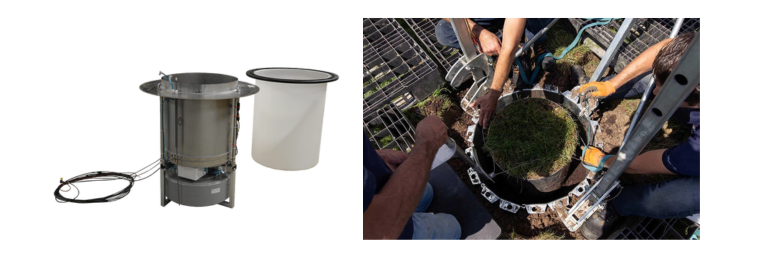
- • Large diameter stainless steel vessel (typically Ø300–500 mm or more) with height up to 600–900 mm, built to house an undisturbed soil monolith.
- • Precision weighing (load cells) to detect changes in mass corresponding to evapotranspiration, drainage or added water.
- • Integrated soil moisture probes, temperature sensors, optionally suction/tensiometers to capture multi parameter soil state.
- • Drainage/leachate collection system (free drainage or controlled lower boundary) enabling qualitative and quantitative analysis of seepage water.
- • Designed for both lab and field use: supports disturbed or undisturbed soil monoliths for representative measurements.
- • High resolution data logging & optional IoT/telemetry modules for remote monitoring and automated measurements (depending on version).
- • Robust build suitable for long term deployment (weather proof, durable materials) when used in outdoor environments.
Technical Specifications (Typical / Example Values)
Applications / Usage Areas
- • Agricultural research: Monitoring soil water balance, root zone moisture dynamics, irrigation efficiency.
- • Hydrology & climate studies: Measuring actual evapotranspiration, percolation, and soil water fluxes under natural vegetation or crop cover.
- • Environmental monitoring: Ground water recharge assessment, soil contamination leachate capture, ecosystem water budget studies.
- • Water resource management: Data driven insights for irrigation scheduling, drainage design, and sustainable water use planning.
- • Laboratory testing: Controlled experiments with disturbed or undisturbed soil monoliths to evaluate soil hydraulic properties, drainage, evaporation and infiltration.
User Benefits
- • Provides direct measurement of soil water fluxes (evapotranspiration, drainage) rather than relying solely on indirect estimates.
- • High precision and multi parameter sensing enable comprehensive soil water regime analysis.
- • Captures both qualitative (sensor readings) and quantitative (mass change) data for robust research outcomes.
- • Flexible design supports both field deployment and lab experiments, giving versatility.
- • Better decision support for irrigation, drainage, environmental control and water management — yields improved resource efficiency and sustainability.
Considerations / Best Practice
- • Installation of the soil monolith must be done carefully (especially for undisturbed soil samples) to ensure representative soil structure and contact.
- • Regular calibration and maintenance of load cells, sensors, and drainage/collection systems are necessary for accurate long term operation.
- • Ensure proper data logging and power supply (especially for remote telemetry modules) for uninterrupted monitoring.
- • Account for site specific factors (soil type, root coverage, climate) when interpreting results — each system may need custom calibration or baseline tests.
- • When used outdoors, ensure durability against weather conditions (moisture, temperature extremes) and stable installation to avoid measurement errors.



 CALL US
 WHATSAPP
 LOCATION