Xtreem Multi-Profile Soil Moisture Recording Meter
The Xtreem Multi-Profile Soil Moisture Recording Kit is a field-ready instrumentation system designed for monitoring soil volumetric moisture content and temperature across multiple depths (up to five levels) from a single probe assembly.
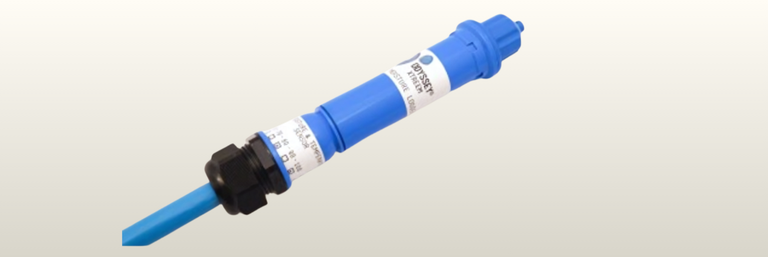
The system includes a multi-depth sensor probe, an integrated logger with wireless connectivity (Bluetooth® LE), and an access tube kit for installation in the ground. The logger stores data on board and when in range of a mobile device it can sync the data via the free Odyssey® Xtract app and send it to the cloud for remote viewing and analysis.
This is ideal for soil-moisture profiling in agriculture, environmental monitoring, vadose‐zone hydrology, root-zone studies and precision irrigation applications. The “multi-profile” design means you can monitor moisture at multiple depths with one installed probe rather than separate sensors for each depth.
Key Features / Highlights
- • Measures soil moisture at up to 5 discrete depths in one probe.
- • Also monitors soil temperature at each sensor depth plus ambient logger temperature.
- • Wide moisture measurement range: 0.00 % to 100.00 % with a resolution of 0.01 %.
- • Depth variants available: e.g., 3-sensor probe (10, 30, 40 cm), 4-sensor probe (10, 20, 30, 40 cm), 5-sensor probe (10, 20, 30, 40, 50 cm) or 1.0 m depth version (10, 20, 40, 60, 100 cm).
- • Logger features wireless Bluetooth connectivity and is compatible with Android phone/tablet; data upload to cloud via Amazon AWS.
- • Durable design: operating temperature –20 °C to +55 °C, IP67 waterproof rating.
- • Long battery life: up to ~2 years (based on 10-minute logging interval with 5 sensors).
- • Field installation kit: includes access tube, cap, impact plug, spanner, batteries, 1 year cloud-data licensing.
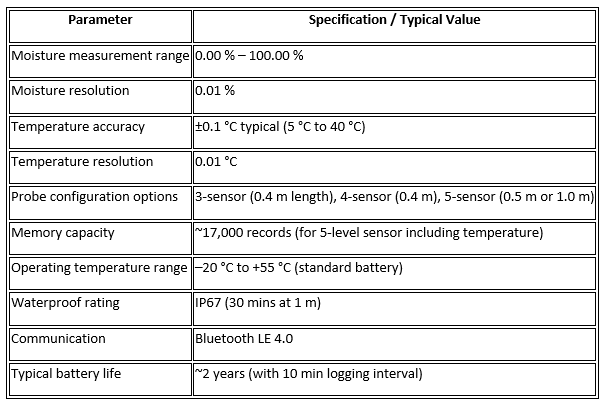
Technical Specifications (Typical / Example Values)
Applications / Usage Areas
- • Agricultural root-zone monitoring: understanding how moisture varies with depth under crop fields or controlled trials.
- • Precision irrigation: evaluating moisture profiles to optimise irrigation scheduling, water use efficiency and drought stress.
- • Soil hydrology & vadose‐zone research: investigating moisture movement, infiltration/redistribution, dry-down cycles.
- • Environmental and climatic monitoring: long-term soil moisture trends in ecosystem studies, climate response.
- • Infrastructure and civil engineering: soil moisture monitoring beneath structures or around pipelines where moisture profile matters.
- • Education and research labs: profiling moisture rather than single-point, enhancing understanding of layered soil processes.
Benefits / User Advantages
- • One installation provides a multi-depth soil moisture and temperature profile, reducing number of separate sensors and simplifying installation.
- • Wireless data retrieval and cloud upload means less field labour (no manual data-logging retrieval) and easier remote monitoring.
- • High resolution moisture measurement (0.01%) enables detection of subtle changes in soil moisture – useful for research and precision agriculture.
- • Long battery life and robust housing reduce maintenance and downtime in remote field sites.
- • Customisable probe lengths and sensor depths allow tailoring to site conditions (crop root-zone, soil depth, research needs).
- • Data is timestamped, stored internally, and can be visualised via mobile app/portal – convenient for clients, researchers and end-users.
Best Practices & Consideration
- • Installation: Ensure access tube is installed vertical, at correct depth, and the sensor probe is inserted correctly to ensure full soil contact and minimal disturbance.
- • Soil contact: Avoid large air gaps around the sensor rod; pack soil around tube properly so the sensor senses the surrounding soil volume accurately.
- • Logging interval: Choose a logging interval that matches your application – shorter intervals give more data but reduce battery life; longer intervals extend battery life.
- • Calibration & soil type: Although factory-calibrated, soil type (texture, salinity, organic matter) can influence results; check for any required calibration or correction.
- • Data management: The device links to the cloud via Bluetooth to a phone/tablet which then uploads; ensure you establish connectivity and data licence is maintained.
- • Battery & maintenance: Although battery life is ~2 years under standard conditions, monitor battery status if logging at high frequency or under cold conditions.
- • Environmental conditions: While the logger is rated to –20 °C, performance may degrade below 0 °C; consider thermal protection or retrieval in extreme cold climates.
- • Probe selection depth: Choose appropriate probe depth configuration (3, 4 or 5 sensors) based on crop root zones or hydrology horizon of interest.
- • Data interpretation: Multi-depth data enables profiling, but remember that readings reflect the volume influenced by the sensor (e.g., radius of influence ~8.5 cm) not point only.



 CALL US
 WHATSAPP
 LOCATION