UGT Ready-To-Go Lysimeter
The Ready-To-Go (RTG) Lysimeter by UGT is a compact, weighable lysimeter station designed for field research of soil-water processes, evapotranspiration, soil-solution leachate and ecosystem water balance investigations.
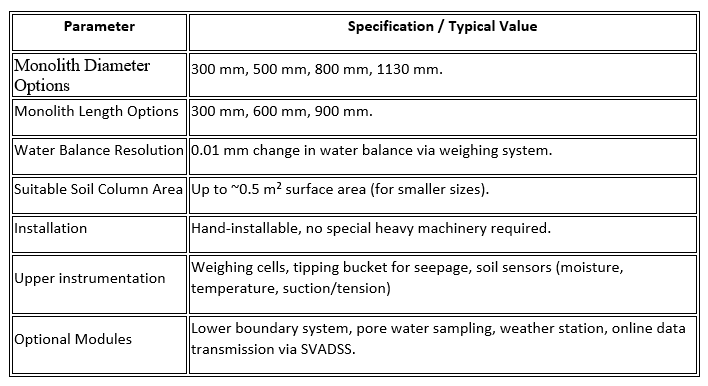
It supports soil columns (monoliths) of various diameters and lengths (300 mm up to 1130 mm diameter; lengths up to 900 mm) — suitable for both disturbed (hand‐filled) and undisturbed monoliths via UGT’s monolith extraction technology.
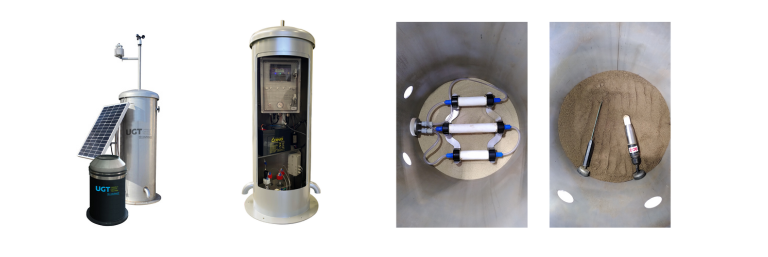
The RTG system includes a lysimeter vessel, precision weighing system, leachate collection tank with tipping bucket, instrumentation for soil hydrological sensors (moisture, temperature, tensiometers/suction probes) and a control/data logger unit.
Its key strength is enabling direct measurement of water balance components under real field conditions with a “plug & play” installation—that means minimal machinery needed, recommended for cost‐effective field studies.
Key Features/Highlights
- • Compact size and cost‐efficiency — smaller footprint than large lysimeter stations.
- • Weighable lysimeter system with resolution down to 0.01 mm change in water balance — enabling detection of small evapotranspiration, dew, snow.
- • Modular size options: diameters 300 mm, 500 mm, 800 mm, 1130 mm; lengths 300 mm, 600 mm, 900 mm.
- • Compatible with both disturbed fill and undisturbed soil monoliths (user or UGT‐extracted).
- • High‐precision instrumentation: full‐range tensiometers (up to ~1500 kPa suction) in many versions, soil moisture & temperature probes included.
- • Plug & play installation: no heavy machinery required, user installation possible.
- • Expandable: optional modules like pore water extraction system, lower boundary control, weather station, online data management (SVADSS).
Technical Specification
Applications /Usage Areas
- • Field studies of soil water balance: evapotranspiration, infiltration, leachate collection under natural conditions.
- • Ecosystem research: using undisturbed soil monoliths to replicate soil processes in situ.
- • Agricultural research: irrigation studies, crop water use, soil‐plant‐atmosphere interactions.
- • Hydrology & environmental monitoring: quantifying water fluxes, leachate chemistry, groundwater recharge estimation.
- • Research where cost, logistics or space constrain use of large lysimeter stations.
Benefits /User Advantages
- • Lower cost entry into lysimeter technology compared to large stations.
- • Manageable size and easier transport/install — suitable for many field sites globally.
- • Versatile: supports both disturbed and undisturbed monoliths, enabling higher fidelity research.
- • Strong data capabilities: precise weighing + soil sensors allow integrated understanding of soil water dynamics.
- • Modular and scalable: can add weather station, lower boundary control, online data access — future‐proof investment.
Best Practice & Considerations
- • While installation is simpler, ensure the vessel is properly leveled and stable to maintain weighing accuracy — poorly leveled systems will bias water‐balance results.
- • Smaller diameter/length monoliths have higher boundary effects (edge influences) compared to larger lysimeters; data interpretation should consider these influences.
- • For undisturbed monoliths, ensure proper extraction technique using UGT’s recommended method or use disturbed fill as appropriate to research design.
- • Guarantee good sealing around the base and vessel to prevent unwanted lateral flow or evaporation loss outside the system.
- • Calibration/validation: verify weighing cells, tipping bucket, and sensors periodically to ensure long‐term accuracy.
- • Data interpretation: remember that monoliths represent a soil column of defined size — scale up cautiously to field scale, considering lateral flows, root interactions, heterogeneity.
- • Consider maintenance of sensors (tensiometers, soil moisture, temperature) and seepage tank system (clean tipping bucket, pump if used).
- • For field installations, anchor the system and protect from vandalism, animals, extreme weather or settlement that might disturb weighing accuracy.



 CALL US
 WHATSAPP
 LOCATION