Soil Penetrometer
A soil penetrometer is a field and/or lab instrument designed to measure the resistance of soil to penetration. By pressing or driving a conical tip into the soil and recording the force required, it quantifies compaction, bearing capacity, root‐zone restriction and structural integrity of the soil. Used in agriculture, geotechnical investigations, civil engineering and turf management, this instrument is essential for assessing soil physical condition and suitability for plant growth or construction.
The Soil Penetrometer enables users to identify compacted layers, measure soil strength, predict how easily roots can grow, and help in making decisions about tillage, soil amelioration and foundation design.
Key Feature
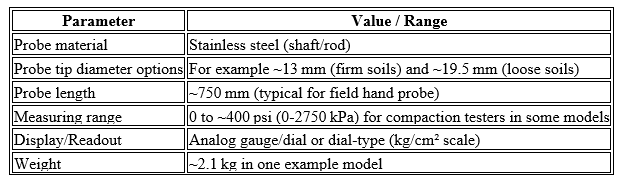
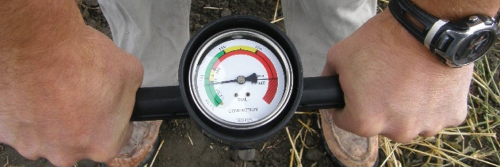
- • Direct reading of penetration resistance (commonly in psi, kg/cm² or similar units) for quick assessment of soil compaction.
- • Portable, rugged construction for field use (stainless steel probe, robust handle) and often includes markings for depth and interchangeable tips for different soil types.
- • Adjustable tip/rod lengths and probe diameters allow for adaptability across soils (loose to firm), ensuring meaningful readings in varying ground conditions.
- • Simple gauge or digital readout makes it user‐friendly; some models retain the maximum reading after release for better logging.
- • Provides actionable data: helps assess whether soil is restricting root growth (often >300 psi indicates root penetration difficulty) and therefore guides agronomic or engineering decisions.

Applications
- • Agriculture & Horticulture: Assess soil compaction in root zone, determine when to till, check effect of tractors/livestock.
- • Soil Science & Research: Study structural changes in soil over time, correlate resistance with root growth, infiltration and aeration.
- • Civil & Geotechnical Engineering: Preliminary evaluation of bearing capacity, subgrade strength, compaction quality.
- • Turf & Landscape Management: Measure compaction on sports fields, lawns, golf courses to maintain root health and drainage.
- • Construction & Site Investigations: Quick field screening tool prior to further lab testing or full geotechnical investigation.
Benifits To Users
- • Rapid, on‐site feedback on soil condition; no need to wait for lab results.
- • Helps identify compacted layers that restrict root growth or drainage, improving productivity or structural design.
- • Durable and simple to use — field personnel can operate with minimal training.
- • Adaptable across many soil types and uses — from agronomy to geotech.
- • Provides quantifiable data for decision making (tillage, amendment, compaction correction, site readiness).
Best Practice /Considersation
- • Ensure soil moisture conditions are consistent when comparing readings; wetter or drier states affect resistance.
- • Use correct tip size for the soil type: small tip for firm soils, larger tip for looser soils; incorrect tip alters the reading.
- • Insert probe at a steady rate to avoid dynamic effects; sudden force/fall may skew results.
- • Clean the probe tip and inspect for damage to maintain accuracy.
- • For engineering use, understand that penetrometer readings are preliminary; may need correlating with other tests for design decisions (bearing capacity, etc).
- • Depth markings and multiple insertions at different locations improve representativeness of results.



 CALL US
 WHATSAPP
 LOCATION