TEROS 11 Advanced Soil Moisture & Temperature Sensor
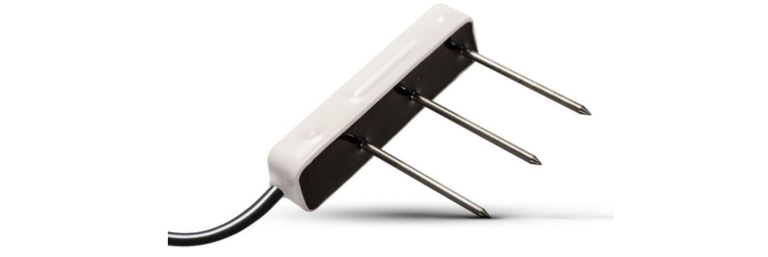
The TEROS 11 from METER Group is a ruggedised, high-precision soil moisture and temperature probe built for long-term field installations even under challenging conditions. It uses 70 MHz capacitance technology with sharpened stainless-steel needles and an epoxy body that resists salts and harsh soil environments.
With a compact 9.4 cm length and an impressive one-litre “volume of influence”, it delivers highly reliable volumetric water content (VWC) readings while minimising the sensor-to-sensor variability.
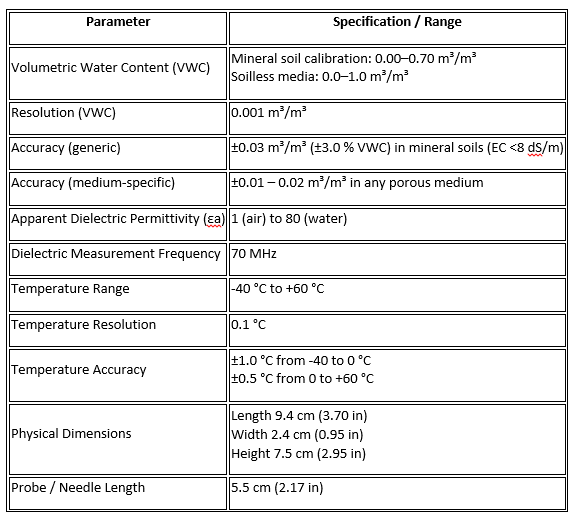
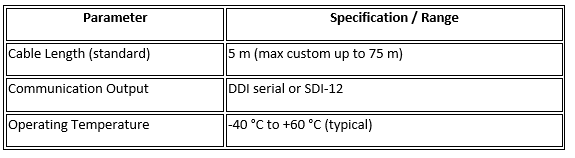
Additionally, it measures soil temperature (-40 °C to +60 °C range) and supports common datalogger protocols (SDI-12 / DDI) for seamless integration.
Key Feature
- • Large volume of influence (~1010 mL) for more representative soil measurements.
- • Rugged epoxy body and stainless steel sensor-needles: built for harsh, saline or exposed soils.
- • 70 MHz high-frequency dielectric measurement: minimises effects of soil texture and salinity.
- • Measures both volumetric water content (VWC) and temperature in one device.
- • Low power consumption and fast measurement response — suitable for long-term sensor networks.
- • Compatible with SDI-12 / DDI protocols and many dataloggers.
- • Verified calibration procedure: ensures reduced sensor-to-sensor variability and more consistent results.
Technical Specifications
Application
- • Soil moisture monitoring in agronomy and precision-agriculture: helps optimise irrigation by accurately measuring soil water content and temperature.
- • Environmental & hydrological studies: monitoring soil moisture and temperature dynamics, water balance and land-atmosphere interactions.
- • Large sensor networks in research & field sites: because of long-term durability and consistent calibration, ideal for deployments in farms, research plots and remote sites.
- • Saline, contaminated or challenging soil conditions: sensor is designed to handle difficult soils (salts, aggressive media) where many sensors degrade.
- • Integration with datalogger systems & telemetry: for continuous monitoring, remote data logging and automated systems.
Benefits / User Advantages
- • High accuracy and performance relative to size: big “volume of influence” gives representative measurements with less disturbance.
- • Durable and low-maintenance: epoxy body and robust components minimise sensor failures and reduce maintenance cost.
- • Long-term field viability: built to last 10+ years in typical field conditions.
- • Compatible with standards and industry systems (SDI-12, DDI): adaptable to many setups.
- • Reduced sensor variability: thanks to verified calibration, data from multiple sensors is more comparable.
- • Faster, easier installation with tools and design that minimise errors (air gaps, poor contact).
- • Single sensor measures both moisture and temperature, reducing equipment count.
Best Practice & Consideration
- • Ensure proper soil contact: the stainless steel needles must be fully embedded in soil and ensure minimal air gaps for accurate measurements.
- • Choose correct calibration: if soils or media deviate (e.g., high salinity, different texture) consider a site-specific calibration to improve accuracy (<±0.02 m³/m³).
- • Monitor cable and connector integrity: long cable runs or exposed installation may need protection and verification of signal quality.
- • Use appropriate logger/communication: ensure the data logger supports DDI or SDI-12 and sufficient resolution.
- • Consider installation depth and environment: though sensor is robust, extreme conditions (very high temps, freezing soil) require proper mounting and protection.
- • For long-term networks, verify periodically using the “verification clip” tool to check sensor repeatability.


 CALL US
 WHATSAPP
 LOCATION