FieldScout SC-900 Soil Compaction Meter
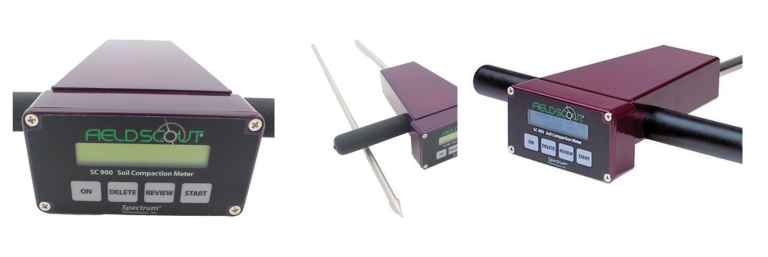
The FieldScout SC-900 Soil Compaction Meter is a professional-grade handheld instrument designed to measure soil compaction in agricultural fields, turf, and research plots. Its precise readings help identify areas of compaction that restrict root growth and water infiltration, guiding decisions about tillage, crop rotation or cover crop planting. It includes cone tips for fine and coarse soils, an ultrasonic depth sensor, internal load cell for penetration resistance, and a data-logger with USB/RS-232 interface for mapping and analysis.
Key Features / Highlights:
- • Includes ½ in and ¾ in cone tips for fine and coarse soils.
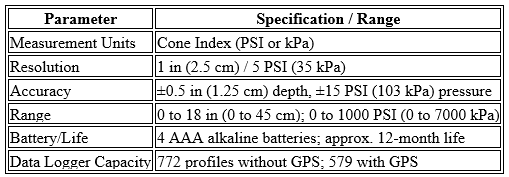
- • Takes compaction readings to a depth of up to 18 in (45 cm).
- • Ultrasonic depth sensor captures readings in 1 in (2.5 cm) increments.
- • Penetration resistance measured by internal load cell; output displayed in PSI or kPa (1 psi ≈ 6.9 kPa).
- • Built-in data logger (up to 772 profiles without GPS; 579 with GPS) and RS-232 port for data download.
- • GPS interface ready, compatible with mapping software (SpecMaps/SpecConnect) for georeferenced field data.
- • Includes carrying case, depth target and USB-to-3.5mm stereo plug adapter.
Technical Specifications (Typical):
Applications / Usage Areas:
- • Agriculture: Identifying compacted layers in fields that restrict root growth and water infiltration.
- • Turf & sports fields: Assessing soil firmness and compaction before turf installation or maintenance.
- • Environmental & research: Evaluating soil structure changes under different management regimes.
- • Precision mapping: Using GPS data to create compaction maps across field zones.
Benefits to Users:
- • Enables targeted soil remediation (tillage, sub-soiling, cover crop) rather than blanket treatment.
- • Helps improve root development, water infiltration and crop yields by addressing hidden compaction.
- • Portable and field-ready for multiple measurements with efficient data logging and mapping capabilities.
- • Supports data-driven decision making and better resource use in field management.
Considerations / Best Practices:
- • Ensure consistent measurement protocol: same insertion rate, probe, moisture condition for comparability.
- • Avoid large rocks, roots or debris when inserting probe – they can skew readings.
- • Interpret results in conjunction with soil texture, moisture, crop root zones and field history.
- • Regular maintenance of probes and components, and use of correct cone tip for soil type (½ in for fine soils, ¾ in for coarse) as per specifications.



 CALL US
 WHATSAPP
 LOCATION