Mini Disk Soil Infiltrometer
The Mini Disk Infiltrometer is a compact, field ready instrument for measuring the unsaturated infiltration rate and hydraulic conductivity of soil under controlled suction. Designed for both field and laboratory use, it makes hydrology and soil science testing significantly simpler and more portable. The device uses a sintered stainless steel disk that contacts the soil surface, with an adjustable suction chamber (Mariotte/ bubble tube) above, enabling the measurement of infiltration under specified negative suction (tension) conditions. This enables hydrologists, soil scientists, agronomists and field engineers to quickly gather data on how water moves into soil under near‐field conditions.
The compact size, minimal water requirement and simple operation make it particularly suitable for remote field sites, classroom demonstrations, and large‐scale spatial surveys where traditional tension infiltrometers would be too bulky or complex.
Key Feature
- • Compact and portable: Just ~32.7 cm long and ~3.1 cm in diameter, making it easy to carry to remote sites.
- • Adjustable suction control: Suction tube allows setting of suction from about 0.5 to 7 cm of water tension, enabling measurements under different pore‐size regimes.
- • Sintered stainless‐steel disk: 4.5 cm diameter, ~3 mm thick, ensuring reliable contact and consistent infiltration measurement.
- • Low water volume required: Only around 135 mL of water needed in the reservoir, making it efficient for field use.
- • Quick setup and minimal calibration: No pre‐saturation required, simple “fill set suction place on soil” workflow.
- • Suitable for a wide range of soils: From sandy to loamy to fine textured soils, useful in research, irrigation design, erosion studies and burn severity studies.
Technical Specification

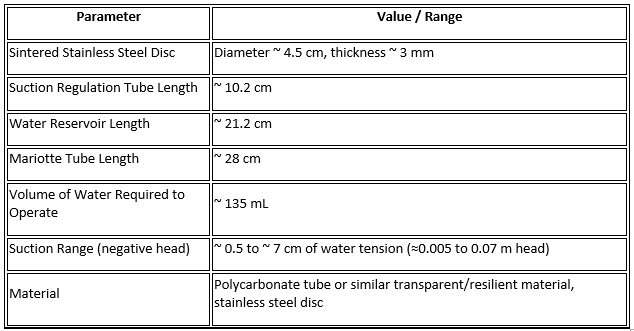
Application
- • Field measurement of unsaturated hydraulic conductivity (infiltration) in soils for water balance, irrigation design, hydrology.
- • Soil texture and structure evaluation: Assessing how quickly water enters different soils and how pore sizes affect flow.
- • Research: Studies on erosion, burn severity, hydrophobic soils, infiltration under varied suction conditions.
- • Education and demonstration: Simple enough for classroom use to show infiltration and unsaturated hydraulic processes.
Benifits To Users
- • Enables rapid, reliable field or lab measurements of infiltration rates from near‐saturated to unsaturated soil conditions.
- • Because of its small footprint and low water requirement, it is very practical for multiple measurement points, enhancing spatial coverage and data reliability.
- • Simple operation reduces the need for specialised training or heavy equipment—valuable for field technicians, agronomists and researchers.
- • Good value and low maintenance, compared to larger infiltrometer systems or full tensiometer arrays.
- • Supports better irrigation and drainage design decisions by providing real infiltration data rather than purely theoretical estimates.
Best Practice / Considerations
- • Ensure the soil surface under the disk is smooth, level, and free of debris to maintain good hydraulic contact. If needed, a thin layer of fine sand or diatomaceous earth can be used between the disk and soil surface.
- • Keep suction settings simple: for many soils a suction of ~2 cm is recommended to start. Larger suctions may require longer time intervals.
- • Record volume vs. time at appropriate intervals depending on soil texture (e.g., seconds for sand, tens of seconds for silt, minutes for clay) to ensure accurate infiltration rate calculation.
- • Because the disk is small, ensure that the selected area is representative of the soil condition—avoid zones with stones, roots or extreme heterogeneity.
- • Use the provided spreadsheet macro or other analysis tool to convert volume vs. time data into hydraulic conductivity or infiltration rate.



 CALL US
 WHATSAPP
 LOCATION