27. TEROS 54 Soil Moisture Profile Probe
The TEROS 54 is an advanced multi‐depth soil moisture and temperature profiling probe from METER Group, designed to measure volumetric water content (VWC) and soil temperature at multiple depths (15 cm, 30 cm, 45 cm & 60 cm) all in one sensor body.
It combines ease of installation — only requiring a 2 cm borehole in many cases — with research‐grade accuracy, allowing root‐zone monitoring without the need for large trenches or multiple separate sensors.
Ideal for agronomic research, precision irrigation, environmental monitoring and seasonal crops where sensors may need to be removed and re-installed.
Key Features
- • Multi‐depth measurement: VWC + temperature sensors at 4 depths (15, 30, 45, 60 cm).
- • Simple installation: Requires only a small borehole (≈2 cm diameter) and can be hammered into the soil for direct contact.
- • Quad-fin design (larger measurement volume per depth compared with typical probes) for more robust soil contact and measurement representativeness.
- • Plug‐and‐play compatibility: Single cable to logger, supports DDI Serial, SDI-12, RS-485/Modbus; designed for easier wiring and fewer logger ports.
- • Removable: All sensors in the probe can be extracted at once with a dedicated extraction tool — beneficial for seasonal fields.
- • Robust field durability: Designed for harsh conditions; installation and removal tools available to minimise disturbance.
Technical Specification
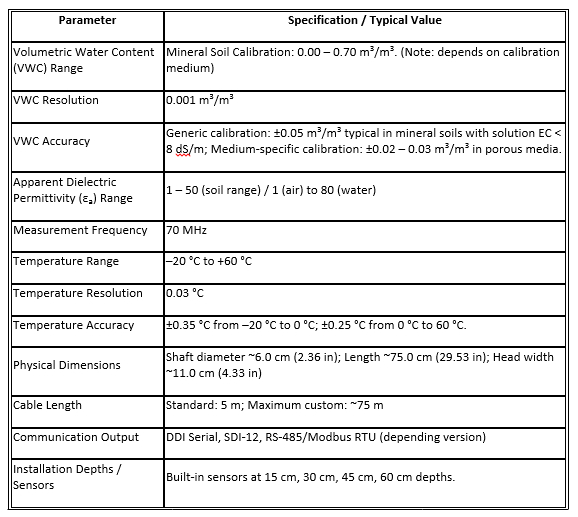
Application /Usage Areas
- • Precision agriculture: monitoring moisture status across root‐zone depths to optimise irrigation scheduling and crop water management.
- • Research & soil science: profiling soil moisture dynamics over time and depth for field experiments or modelling.
- • Environmental and hydrological monitoring: understanding water movement, soil drying/wetting cycles, root zone interactions.
- • Seasonal crop fields: cases where sensors must be installed at planting, removed at harvest, and re‐installed for next season (thanks to extraction tool).
- • Sensor networks: deploying fewer multi‐depth sensors per site, reducing wiring/cable complexity and logger port usage.
Benefits / User Advantages
- • More complete view of the soil profile: One instrument covers 4 depths rather than deploying separate sensors at each depth — saving cost, wiring and labor.
- • Easier installation & removal: Reduces need for large trenches, pilot tubes or major soil disturbance; suitable for annual crops or fields requiring seasonal sensor changes.
- • High accuracy & research‐grade data: Accurate volumetric moisture and temperature data mean reliable decisions and credible research output.
- • Compatibility & integration: Works with modern data loggers/telemetry platforms and cloud data systems (ZENTRA Cloud via METER).
- • Efficient wiring: One cable handles multiple depths, reducing clutter and the number of logger channels required.
- • Broad soil application: Calibrated for mineral soils and adaptable via custom calibration to other media — versatile across field types.
Best Practices & Considerations
- • Ensure good soil contact: For best performance, the probe must be installed with minimal air gaps; using the correct auger hole or slide-hammer installation as recommended improves measurement reliability.
- • Choose appropriate location & depth: Given the built‐in depths (15, 30, 45, 60 cm), select a probe location where these depths map well to your crop root zone.
- • Protect and route the cable properly: Given the long cable length options (up to ~75 m), plan for cable protection, conduit, and logger port management.
- • Review calibration needs: While the generic calibration gives good accuracy, if you are working in highly unusual soils (very high salinity, organic matter, or non-mineral media) consider the medium-specific calibration for improved accuracy.
- • Plan for seasonal removal if needed: If your site is tilled or replanted, use the dedicated extraction tool for safe removal without damaging the sensor.
- • Monitor data continuity: Because you’re getting measurements at four depths, check that all depths are functioning and that sensor readings correlate logically (e.g., drying trends at deeper depths follow shallower readings).
- • Interpret in context: Remember this measures volumetric moisture content + temperature — other variables (e.g., root uptake, solute transport) may still require additional instrumentation.



 CALL US
 WHATSAPP
 LOCATION