PRESSURE PLATE APPARATUS
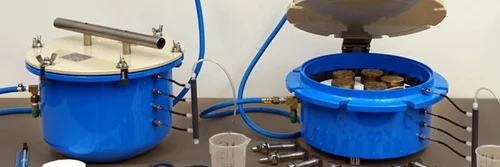
The Pressure Plate Apparatus is a laboratory-grade instrument designed for the accurate measurement of soil moisture characteristics under controlled suction (air pressure) conditions. By placing soil samples on a porous ceramic or membrane plate inside an airtight chamber and applying regulated positive air pressure, water is gradually extracted from the soil until equilibrium is reached. This allows the generation of the Soil-Water Characteristic Curve (SWCC), which is essential for a range of geotechnical, agricultural and environmental applications.
The robust construction, wide suction range and multi-sample capacity make this equipment ideal for research laboratories, irrigation and drainage studies, unsaturated soil mechanics and environmental soil-water investigations.
Key Features
- • Heavy-duty sealed chamber with O-ring gasket and clamping bolts ensures consistent pressure control and leak-free operation.
- • High-quality porous ceramic plates or membranes provide reliable flow of water from soil samples while preserving sample integrity.
- • Versatile pressure range—typical models cover from 0 to 5 bar up to 15 bar (or higher) to measure from field capacity to near wilting-point moisture conditions.
- • Multi-cell configuration allows testing of multiple soil samples simultaneously, increasing throughput and cost-efficiency.
- • Compatible with both disturbed and undisturbed soil cores—preserving in-situ structure when required.
- • Suitable for a broad range of applications: soil water retention, available water capacity, hydraulic conductivity under suction, and calibration of soil-moisture sensors.
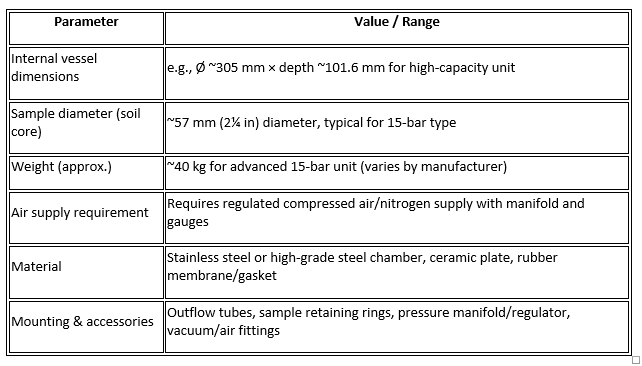
Technical Specifications (Typical / Example Values)

Applications
- • Determination of Soil-Water Characteristic Curve (SWCC) for research and engineering design.
- • Agriculture & irrigation engineering: assessment of field capacity, available water capacity, crop water stress and irrigation scheduling.
- • Geotechnical engineering: behaviour of unsaturated soils, suction-dependent shear strength, slope and foundation stability under partial saturation.
- • Environmental and contamination studies: extraction of soil solution, moisture movement under suction, assessment of unsaturated permeability.
- • Calibration of in-field soil-moisture sensors and water-potential blocks using controlled suction reference points.
User Benefits
- • Generates high-precision moisture–suction data, enabling informed decisions in soil-water and geotechnical analysis.
- • Multi-sample capacity reduces testing time per sample and increases laboratory productivity.
- • Built for durability and repeated cycling under pressure — long-term reliability for research and industrial labs.
- • Wide suction range covers from near-wet to near-dry (wilting point) moisture regimes.
- • Adaptable across multiple disciplines — agriculture, geotechnics, environment — making it a versatile investment.
Best Practice / Considerations
- • Ensure all seals, O-rings and clamping bolts are properly tightened and maintained to avoid pressure leaks and ensure accurate results.
- • Samples must be properly saturated and prepared before testing to ensure reproducibility and reliability of the moisture–suction relationship.
- • Porous ceramic plate or membrane should be fully wetted (no air trapped) before starting the suction procedure to avoid measurement artefacts.
- • Each pressure stage must be allowed sufficient time for equilibrium (no further outflow) before recording water content — time will vary with soil type and pore structure.
- • Air supply system (compressor or bottle) must include a regulated manifold with accurate gauges and valves to control pressure increments precisely.



 CALL US
 WHATSAPP
 LOCATION