Green Seeker Handheld Crop Sensor
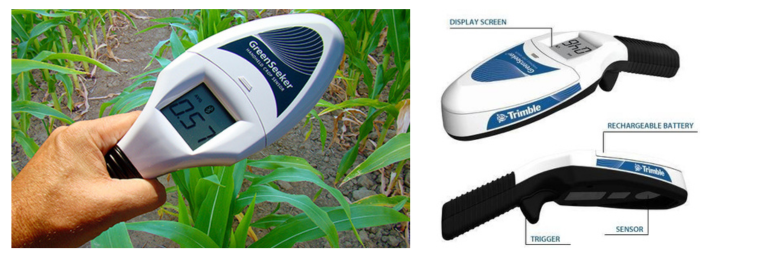
The GreenSeeker Handheld Crop Sensor is a portable, precision optical instrument designed for rapid in field measurement of crop health via the Normalized Difference Vegetation Index (NDVI). Developed by Trimble, this device allows agronomists, farm managers and precision agriculture consultants to assess plant vigour and biomass, make informed nutrient management decisions (such as nitrogen application) and monitor crop stress, canopy growth and potential yield.
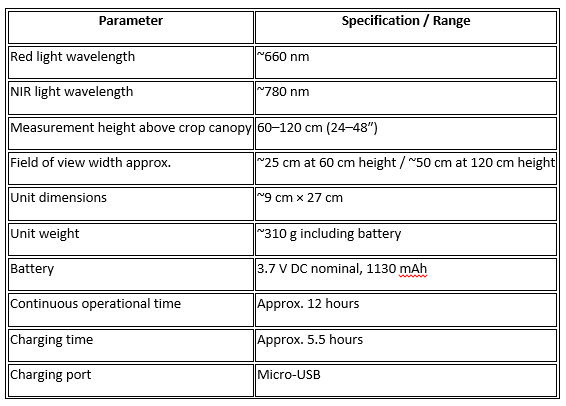
By emitting short bursts of red (≈ 660 nm) and near infrared (≈ 780 nm) light and measuring their reflection from plant leaves, the GreenSeeker computes an NDVI value (0.00 0.99) which correlates to crop health: higher NDVI indicates healthier, more vigorous vegetation.
While hand held, the sensor integrates easily into field workflows—simply point it 60–120 cm (24–48″) above the canopy, press the trigger, and get a reading. Multiple readings across a field allow mapping of crop variability and help determine site specific fertilizer rates, thereby helping increase yield and reduce input costs.
Key Features / Highlights
- • Active optical sensor – emits bursts of red & NIR light and measures the reflected light to calculate NDVI instantly.
- • Instant readings displayed on a bright LCD—even in bright sunlight.
- • Trigger based measurement: while the trigger is pulled the sensor continuously samples; on release it returns an averaged value.
- • Field of View (FOV) approx. 10″ (25 cm) when held ~24″ (60 cm) above canopy; approx. 20″ (50 cm) at 48″ height.
- • Ergonomic handheld design with comfortable grip, lightweight (~310 g) unit for easy field use.
- • Rechargeable battery (3.7 V nominal, ~1130 mAh) supporting ~12 hours of operation; recharge via Micro USB.
- • Bluetooth connectivity (BLE) option for linking to smartphones or tablets and uploading data/logs.
- • Helps enable variable fertilizer rate decisions, optimize nitrogen usage, and support sustainable crop management.
Technical Specifications

Applications / Usage Areas
- • Precision agriculture: Monitoring crop health mid season, determining nitrogen and other nutrient requirements, adjusting variable rate fertilizer applications.
- • Agronomic research: Establishing relationships between NDVI readings and crop yield potential, biomass, leaf area index, stress detection.
- • Crop scouting and management: Field advisors and agronomists can rapidly assess crop vigour across multiple zones to decide where inputs are needed.
- • Sustainability & input optimization: Reducing unnecessary fertilizer usage by basing application decisions on objective crop sensor data rather than only visual inspection.
Benefits To Users
- • Quick, actionable field readings instead of waiting for lab analysis → better timeliness of decisions.
- • Objective data (NDVI) that reduce guesswork in crop health assessment and nutrient management.
- • Helps increase yield potential while reducing input costs (fertilizer savings) and environmental impact.
- • Lightweight and handheld—easy to carry and use across multiple field zones.
- • Data connectivity allows logging, mapping and integration with precision agriculture workflows.
- • Offers flexibility across crop types, field sizes and variable rate management scenarios.
Considerations / Best Practice
- • For best consistency, hold the sensor at a consistent height (60–120 cm) above the crop canopy and maintain a steady pace while scanning. Inconsistent height or speed can affect readings.
- • Ensure good contact with the crop canopy: avoid large gaps, overly tall crop or sparse cover where readings may be less representative.
- • Use the sensor readings in context with crop type, growth stage, and field history—NDVI gives you a relative measure of vigour, not absolute nutrient content.
- • For estimating fertilizer rate, often calibration references are needed: e.g., using an “N‐rich strip” within the field as a reference area.
- • Battery must be charged and the unit maintained; firmware/software updates may be needed for logged data integration.
- • Although the device gives NDVI readings, decision support algorithms or nutrient rate charts should be adapted to your crop, region, soil condition, etc.

 CALL US
 WHATSAPP
 LOCATION