Plant Leaf Porometer
A Leaf Porometer is a portable handheld instrument designed to measure stomatal conductance (and/or stomatal resistance) of plant leaves. Stomatal conductance is a key indicator of how open the stomata are on a leaf surface, thus relating to transpiration rate, plant‐water stress, CO₂ uptake, and overall plant health.
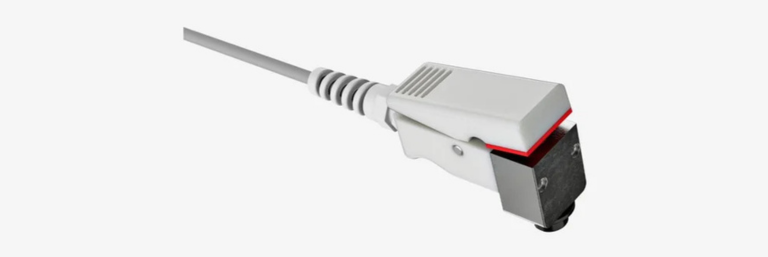
By clamping or placing the porometer sensor head onto a leaf surface, the device measures the rate at which water vapour diffuses through the stomata of the leaf and reports this as conductance (e.g., mmol m⁻² s⁻¹) or resistance (s m⁻¹) units. This non destructive approach is well suited for agronomy, plant science research, irrigation scheduling, phenotyping and environmental stress studies.
Key Feature
- • Quick measurement: e.g., the model SC 1 Leaf Porometer features a measurement time of ~30 seconds in auto mode.
- • Portable and field‐ready: battery powered, lightweight design, no bulky pumps or tubes required.
- • Multi unit output: can display results in various units like mmol m⁻² s⁻¹ (conductance), m² s mol⁻¹ (resistance), s m⁻¹ (resistance).
- • Data logging: Many models store thousands of measurements and support download via USB/serial interface.
- • Minimal calibration: Some models allow field calibration or calibration via known standard plates.
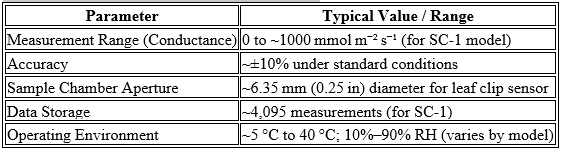
Technical Specifications (Typical / Example Values)
Application
- • Monitoring plant water status and stress in crops, orchards, greenhouses.
- • Research on stomatal function, gas exchange, transpiration and photosynthesis.
- • Agronomic decision‐making: correlating stomatal conductance with irrigation scheduling, fertiliser use, crop physiology.
- • Phenotyping in plant breeding: comparing varietal responses to drought or environmental change.
- • Environmental/air‐pollution effects: assessing how pollutants/herbicides affect stomatal behaviour.
Benifits to users
- • Non‐destructive and rapid measurement allows repeated readings on the same leaf over time.
- • Enables field measurement without waiting for lab results; helps in timely decision making.
- • Provides quantifiable data related to plant physiology and stress, rather than only visual signs.
- • Data logging capability supports tracking over time and analysis of trends.
- • Helps researchers, agronomists and horticulturists more precisely link leaf‐level behaviour to whole plant/canopy outcomes.
Best Practice /Consideration
- • Ensure the leaf chosen for measurement is representative of the canopy and is healthy (avoid severely wilting, damaged, or shaded leaves).
- • Maintain consistent measurement conditions (time of day, light level, leaf position) to compare readings meaningfully.
- • Understand that stomatal conductance is influenced by multiple factors (light, humidity, CO₂, leaf temperature), so interpret in context.
- • Some models require a desiccant or sealed environment around the leaf clip; ensure no condensation, leaks or movement during measurement.
- • For best results, download data, annotate conditions (leaf ID, plant, time, conditions) and review trends rather than single values.



 CALL US
 WHATSAPP
 LOCATION