Pan Evaporimeter
A Pan Evaporimeter is a meteorological/hydrological instrument designed to measure the rate of evaporation of water from a contained free‐water surface. It integrates the effects of temperature, wind, humidity, solar radiation and water availability.
Typically, the pan is filled to a defined water depth and the water loss (evaporation) over a period (often 24 hours) is measured to compute evaporation in millimetres of water depth.
Commonly used in irrigation scheduling, hydrological studies and meteorological monitoring, the measurement from a pan is often converted to reference evapotranspiration or larger surface evaporation using a “pan coefficient”.
- • Complies with international standards (e.g., WMO guidelines for “Class A” pan) for consistent measurements.
- • Simple principle: measure water loss from known surface area over time — makes for relatively low cost and field friendly installation.
- • Optional automation: some models include level sensors (piezometric or capacitive) and data logger outputs to monitor water level continuously and automate refill.
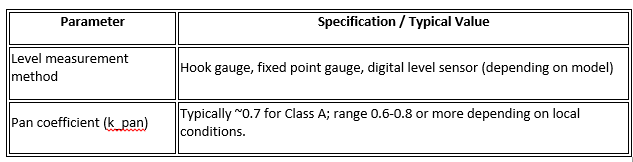
- • Conversion to reference evapotranspiration: by applying pan coefficient (e.g., ~0.7 for Class A) the pan measurement can serve as proxy for free‐water or crop evapotranspiration.
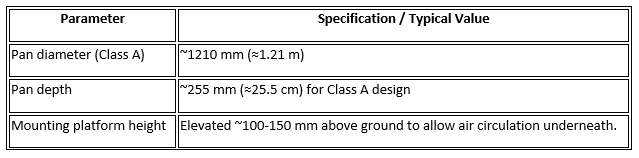
Technical Specifications (Typical / Example Values)
Applications /Usage Areas
- • Meteorological stations: monitoring evaporation as one component of water‐budget/hydrological studies.
- • Irrigation scheduling: estimating water demand or evaporative losses for crop management.
- • Lake, reservoir or open‐water surface studies: estimating free water evaporation and scaling from pan measurements.
- • Agricultural research & hydrology: comparing evaporation under different land‐use, crop cover or climate zones.
- • Educational and experimental setups: showing effects of wind, humidity, temperature and radiation on evaporation.
Benifits /User Advantages
- • Relatively low cost, straightforward to install and operate compared to full meteorological stations.
- • Provides a real‐time integrative measurement of evaporation, combining multiple climatic influences.
- • Useful proxy for evapotranspiration and helps in water‐resource planning in agriculture/hydrology.
- • Can be automated (with sensors & data loggers) for continuous monitoring and remote data collection.
- • Standardised design (e.g., Class A) ensures comparability across sites and times.
Best Practices & Considerations
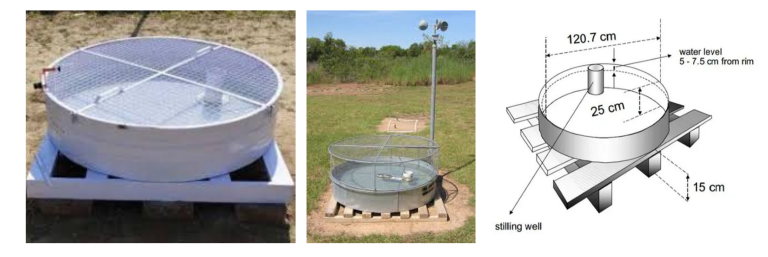
- • Sit the pan in a representative location: ground cover, exposure to wind and sun, unobstructed by trees/shrubs.
- • Measure daily or at consistent intervals; account for rainfall: if rain falls into pan, it must be subtracted from the loss measurement.
- • Apply the correct pan coefficient (k_pan) when converting the measured evaporative loss to reference evaporation or crop evapotranspiration — local conditions can cause variation.
- • Be aware of limitations: Pan evaporation often overestimates actual surface or crop evaporation due to material/geometry differences (metal sides heat up, shallow depth, increased wind effect). Correction factors or calibration with actual evapotranspiration are needed.
- • Ensure level sensor (if digital) is properly calibrated; for manual systems use hook gauge or graduated cylinder with care to precision.
- • Consider environmental controls: the pan should be placed on a stable, level surface; platform should be white or reflective to minimise additional heating.



 CALL US
 WHATSAPP
 LOCATION