Soil Sampling Augers
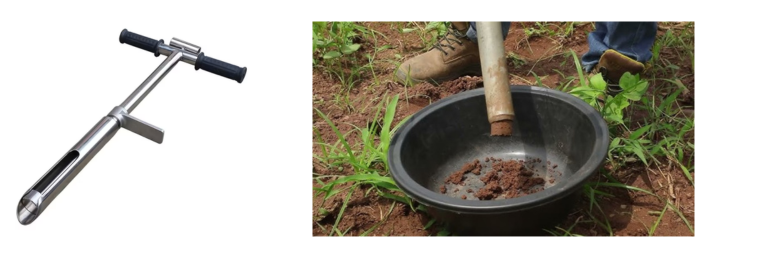
Soil sampling augers are hand-operated tools designed to extract soil samples at varying depths for agricultural, environmental, geological, and engineering applications. Built to penetrate a wide range of soil types—from loose sands to dense clays—these augers enable consistent, undisturbed sampling for laboratory analysis or field characterization. Their modular design, with interchangeable heads and extension rods, allows users to reach sampling depths from shallow (0–30 cm) to several meters below the surface.
Augers are commonly used in soil fertility assessment, contamination detection, moisture profiling, root-zone evaluation, and geotechnical surveys where accurate, repeatable sampling is critical.
Key Features
- • Specialized auger heads:
Available in multiple geometries (e.g., Edelman, spiral, sand, clay, mud) to optimize sampling efficiency in different soil conditions.
- • Modular, extendable design:
Handles and extension rods allow customizable sampling depth, often up to 3 m or more depending on soil conditions.
- • High-strength construction:
Typically built from hardened steel or stainless steel for durability and resistance to bending or corrosion in wet or abrasive soils.
- • Efficient soil retrieval:
Cutting edges are engineered to capture and hold soil during extraction for more representative sampling.
- • Manual or powered options:
Traditional hand augers for remote or low-impact sampling; mechanical augers available for deep or compacted soils.
Technical Characteristics (Typical)
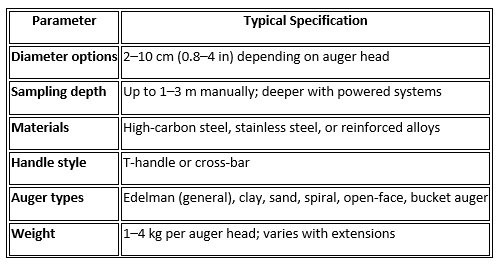
Applications
- • Agronomy & soil fertility testing – nutrient analysis, organic matter evaluation, root-zone characterization.
- • Environmental monitoring – contamination assessment, landfill investigation, groundwater recharge studies.
- • Hydrology & soil physics – infiltration studies, moisture profiling, texture and structure analysis.
- • Geotechnical engineering – subgrade evaluation, construction site assessment.
- • Forestry & ecology – soil horizon characterization and ecosystem research.
Benifits To Users
- • Provides high-quality, representative soil samples for reliable lab or field analyses.
- • Works in remote locations with no need for power or large equipment.
- • Modular design minimizes transportation weight and maximizes sampling flexibility.
- • Suitable for virtually all soil textures when equipped with the correct auger head.
- • Low-disturbance sampling for sensitive sites or monitoring programs.
Best Practices / Considerations
- • Use the appropriate auger head for the soil texture to prevent sample loss or tool damage.
- • For deep or compacted soils, extension rods and proper technique are essential for safe operation.
- • Clean auger surfaces thoroughly between sampling points to avoid cross-contamination.
- • In very loose sands or saturated soils, consider split-spoon samplers or core samplers for better sample integrity.
- • Keep cutting edges sharpened for consistent performance.



 CALL US
 WHATSAPP
 LOCATION