Soil Solution Access Tube Suction Lysimeter
The Soil Solution Access Tube (SSAT) by Irrometer is a suction lysimeter specifically designed for extracting soil water (soil solution) samples at root zone depths for chemical analysis of nutrients, salinity, EC and other dissolved constituents.
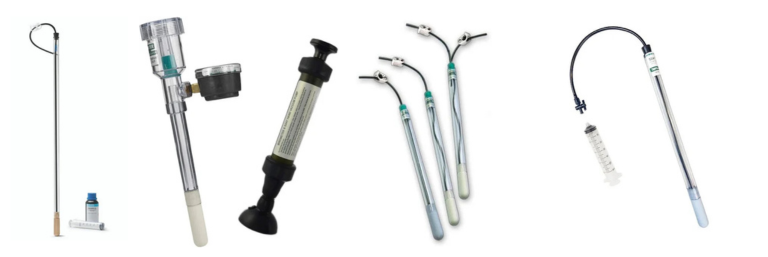
It consists of a sealed tube with a porous ceramic tip at its installation end, inserted into the soil at the desired depth. A vacuum is then applied to draw pore water (soil solution) through the ceramic tip into the tube, enabling collection of fluid samples that reflect the true soil water environment around plant roots or soil media.
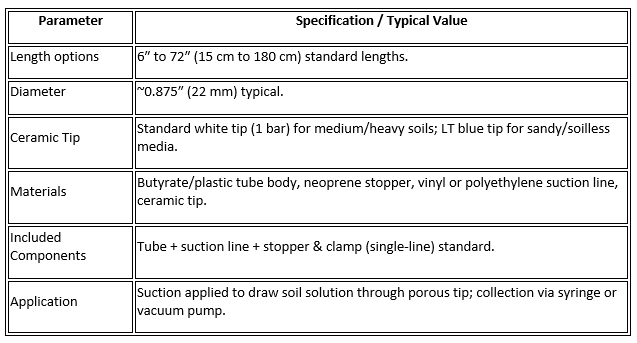
These tubes are available in multiple lengths (6″ to 72″ / 15 cm to 180 cm) and tip types (standard ceramic tip for general soil use, or low tension “LT” ceramic tips for coarse or potting media) making them versatile for agricultural, environmental monitoring, research and fertigation applications.
Key Feature /Highlights
- • Easy to install and operate in root zone or soil profile conditions.
- • Choice of standard ceramic tip (white) for normal soils, or low tension tip (blue) for sandy soils/growing media, enhancing suitability across soil types.
- • Available in a wide range of lengths from ~15 cm up to ~180 cm (6″ to 72″) to match depth of interest.
- • Durable materials: tube body constructed of chemical resistant plastic, leak proof ceramic to plastic junctions, reliable for field or lab installations.
- • Sampling capabilities for critical soil solution parameters: nitrates, EC, salinity, nutrients — aiding irrigation, fertilization and soil water balance decisions.
- • Low maintenance and relatively simple vacuum based extraction system (syringe & stopcock) for obtaining representative soil solution.
Technical Specifications
Applications / Usage Areas
- • Agriculture & irrigation: Sampling soil solution in root zone to evaluate nutrient availability, salinity, or fertilizer leaching.
- • Environmental & hydrology research: Monitoring subsurface solution chemistry, contaminant transport or water balance studies in the vadose zone.
- • Soilless/greenhouse media: Using low tension tip versions for potting mixes or coarse substrates to monitor nutrient solution around roots.
- • Fertigation management & soil water chemistry: Helps growers calibrate fertiliser rates and timing to optimise crop performance and reduce waste.
Benifits/ User Advantages
- • Enables collection of actual soil solution samples from relevant depths, giving more meaningful chemical/physical insight compared to simple bulk soil measurements.
- • Helps informed decision making for irrigation and fertilisation: reduce over application, monitor nutrient leaching, optimise water & chemical input.
- • Versatile across soil types (with tip options) and depths (length options) — suited for a range of field or controlled environment installations.
- • Installed long term if required; minimal disturbance after installation, allowing repeated sampling over time for monitoring.
- • Supports integration into monitoring programs, research studies or agronomic management systems with cost effectiveness and low maintenance.
Best Practices & Considerations
- • Ensure good soil contact around the ceramic tip: avoid air gaps, ensure appropriate depth and back fill materials (e.g., silica flour) to promote hydraulic contact.
- • When installing, ensure the tube length and tip type match soil conditions (heavy vs sandy) and root zone depth for meaningful sampling.
- • Apply appropriate vacuum to extract sample: insufficient vacuum or poor installation may lead to no sample or biased sample.
- • After installation wait for equilibration and sample extraction at appropriate times (post irrigation/flow events) to capture relevant soil solution chemistry.
- • Regularly purge/clean, inspect for clogging of ceramic tip and ensure suction line integrity; clogging can affect sample representativeness.
- • Recognise influence volume is limited (small region around tip) — interpret results accordingly, not a full soil profile snapshot.



 CALL US
 WHATSAPP
 LOCATION