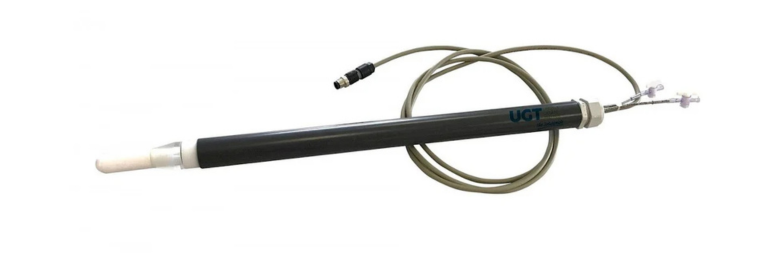
UGT Tensio 152 Pressure transducer tensiometer
The UGT Tensio 152 is a rugged, high precision tensiometer designed for long term monitoring of soil moisture suction (soil water tension) even under challenging environmental conditions. With a stainless steel membrane sensor, frost protected design, and a durable ceramic cup combined with integrated signal amplification, it is especially suitable for contaminated, saline or exposed soils where standard tensiometers may struggle.
This instrument measures the negative pressure (suction) that water in the soil is under (matrix potential) which is crucial for irrigation scheduling, soil water balance studies, geotechnical investigations and environmental monitoring.
Key Features
- • Stainless steel membrane pressure transducer for enhanced durability and corrosion resistance — suited for aggressive and saline soils.
- • Frost protected design: the pressure sensor is located directly above the ceramic cup; only the water filled tank is at installation depth, allowing the system to freeze with the ground and resume function upon thawing.
- • Integrated filling screw for easy user refilling of the tensiometer without full disassembly.
- • Signal output: 0 – 1 V DC (with integrated amplifier) — suitable for dataloggers and continuous monitoring setups.
- • Wide suction (tension) measurement range: 30 to +100 kPa (depending on configuration).
- • Working temperature range of 0 °C to +50 °C for typical installations.
- • Customisable standpipe lengths available on request to adapt to different installation depths.
Technical Specification
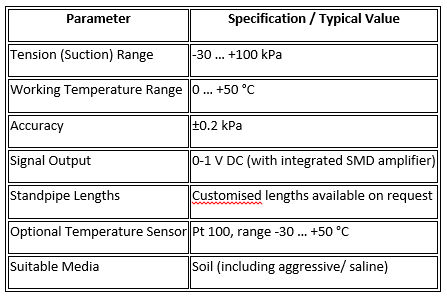
Application/Usage Areas
- • Soil moisture tension monitoring in agriculture: providing data to optimise irrigation by measuring the suction with which plants must extract water from the soil.
- • Environmental monitoring & hydrology: tracking soil water potential for water balance studies, watershed management, moisture flow direction, and unsaturated zone investigations.
- • Geotechnical & civil engineering: assessing soil suction in slopes, embankments, compacted layers or for foundation design where matric suction affects stability.
- • Long term monitoring installations in saline or contaminated soils where conventional tensiometers may fail due to corrosion or freezing.
- • Research & development: soil physics labs requiring reliable suction measurements in aggressive or seasonal environments.
Benifits/User Advantage
- • High durability and reliability even in harsh soil environments (saline, contaminated, seasonally freezing) — reduces maintenance and replacement costs.
- • Continuous monitoring capability with electronic output — enables integration into datalogger/telemetry networks for automated measurement and remote data collection.
- • Frost protected installation ensures year round operation in shallow soils, extending the measurement season without interruption.
- • Allows flexible installation depths and configurations thanks to custom standpipe lengths, making it adaptable to many site requirements.
- • Transparent adapter and integrated filling screw provide easy maintenance, air bubble inspection and user refilling without removing the device from site.
Best Practices & Collections
- • Ensure the ceramic cup is in full contact with the surrounding soil material: poor contact or air gaps reduce accuracy and responsiveness.
- • Install in pre drilled boreholes with diameter slightly smaller than the standpipe to minimise disturbance and ensure good soil contact.
- • Periodically check for air bubbles via the transparent adapter; refill via the screw if necessary to maintain full water column and correct readings.
- • For extremely saline or contaminated soils, frequent checks may be needed to ensure the ceramic cup pore system remains functional. The Tensio 152 is designed for such, but maintenance still needed.
- • Use a compatible datalogger or measurement system that accepts 0 1 V output; ensure proper signal wiring, grounding and calibration as per your system.
- • Although the device is frost protected, ensure to follow installation guidelines for shallow soils in freezing environments to mitigate any freezing related stresses.
- • Consider the measurement range ( 30 to +100 kPa): for suction values beyond this range (i.e., drier soils) alternative full range tensiometers may be needed.


 CALL US
 WHATSAPP
 LOCATION