UGT Hood-Soil Infiltrometer
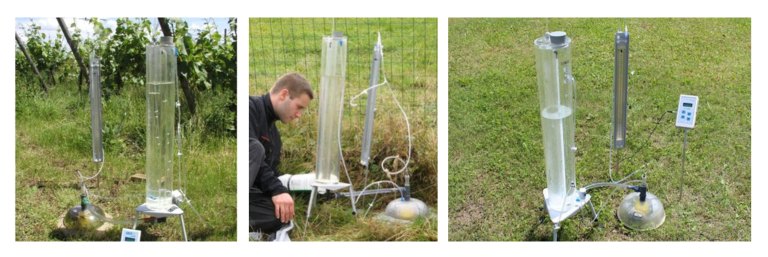
The Hood-Infiltrometer by Umwelt Geräte Technik GmbH (UGT) is a field-grade instrument designed to measure near-saturated and unsaturated soil hydraulic conductivity and infiltration under natural conditions. It consists of:
- • a sealed hood placed directly on the soil surface (open at the bottom) that is filled with water, forming a defined circular infiltration source area;
- • a Mariotte water supply system – an infiltration vessel, bubble tower and aeration tube to maintain a constant pressure head;
- • a U-tube manometer (and optionally pressure sensors) to precisely record the hydraulic pressure head at the soil surface;
One of its key advantages is that no contact layer (such as sand or filter cloth) is required between the hood and the soil surface, enabling infiltration tests with minimal disturbance and more realistic boundary conditions.
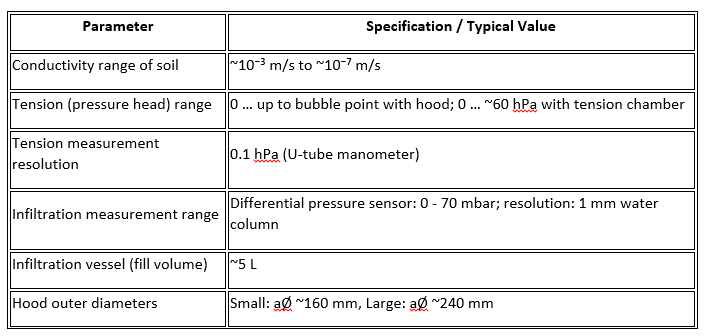
In its standard configuration the device measures infiltration under pressure heads ranging from zero to the air-penetration (bubble) point of the soil; with an optional tension chamber it can also perform infiltration under negative pressure (up to ~60 hPa) for unsaturated conductivity measurements.
This instrument is well-suited for soil science, hydrology, irrigation research, environmental monitoring and field investigations where accurate infiltration and hydraulic conductivity data are needed.
Key Feature /Highlight
- • Direct infiltration from a hood in contact with soil surface — no sand/filter contact layer required, saving prep time and reducing disturbance.
- • Adjustable hydraulic pressure head: from 0 down to negative values (when used with optional tension chamber), enabling measurement under near-saturated as well as unsaturated conditions.
- • Two hood sizes (ratio ~1:2 infiltration areas) allow adaptation to different infiltration conditions (fast/slow soils) for better test matching.
- • Electronic version (IL-2700) records flow rate data via pressure sensor + handheld unit, with software for PC transfer and evaluation; non-electronic version also available for cost-effective field use.
- • Wide conductivity measurement range: capable of measuring soils with hydraulic conductivity between ~10⁻³ m/s to ~10⁻⁷ m/s.
- • Rugged field construction with carrying case, robust hood and components suitable for field conditions.
Technical Specifications

Applications/Usage Areas
- • Measuring near-saturated hydraulic conductivity (Kₛ) of soils in field conditions – e.g., for drainage design, infiltration modelling.
- • Field infiltration tests under controlled pressure heads for soil-hydrological research.
- • Conversion to tension infiltrometer (with optional tension chamber) for unsaturated hydraulic conductivity (K(h)) studies.
- • Soil/land management, irrigation planning, hydrological and environmental assessments in agricultural, forestry and research settings.
- • Monitoring spatial variability of infiltration capacity in different soil types, land uses or treatment areas.
Benefits / User Advantages
- • Realistic field measurement: Because no artificial contact layer is needed, the infiltration tests are closer to natural field conditions with minimal disturbance.
- • Versatile: Adjustable pressure head and hood sizes allow adaptation to a wide range of soil conditions (slow/fast infiltration, saturated/unsaturated).
- • Efficient: Electronic data acquisition option streamlines data logging, reduces manual recording and facilitates PC-based analysis.
- • Research-grade accuracy: The instrument’s design and specifications allow high-quality data suitable for publications, modelling and design.
- • Durable and field-friendly: Carry case, robust components and flexibility for harsh conditions make it practical for site use.
Best Practices & Considerations
- • Ensure the soil surface within the hood area is level and that any vegetation is cut short (≈5 mm) so that the hood seals well to the soil surface.
- • Check that the hood placement avoids entrapped air: the contact between hood and soil must be sealed, and if necessary use a fine sand ring around the hood edge.
- • Allow sufficient time for infiltration to reach steady-state flow before recording data—transient flows will bias results.
- • Choose the correct hood size ratio and pressure head settings for the expected conductivity of the site—fast soils require larger area or higher head to measure reliably.
- • If measuring unsaturated conductivity (via tension chamber), ensure the vacuum/tension settings are correctly applied and bubble points are identified (soil air entry) to avoid air entry affecting flow.
- • Calibrate and evaluate data using appropriate infiltration models (e.g., Wooding 1968) and be aware of lateral flow components under a circular source area.
- • After tests, document site conditions (soil moisture, vegetation, antecedent rainfall) as they significantly influence infiltration results and conductivity estimates.



 CALL US
 WHATSAPP
 LOCATION