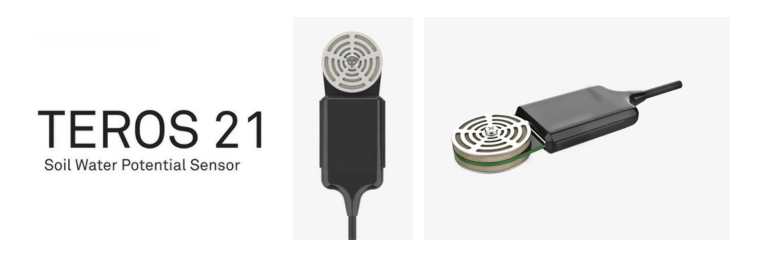
TEROS 21 Soil Water Potential Sensor
The TEROS 21 is a high precision, maintenance free soil water potential (matric potential) sensor designed for long term field or lab deployment. Unlike standard volumetric water content sensors, the TEROS 21 allows you to measure how much water in the soil is available to plants / moving — by measuring soil water potential rather than just water content.
Because matric potential is less dependent on soil type than volumetric content, the TEROS 21 provides more comparable data across different soils.
It has a rugged design, integrates temperature measurement, and supports digital communications (SDI 12 / RS 232) for easy data logging and networked monitoring.
Key Features / Highlights
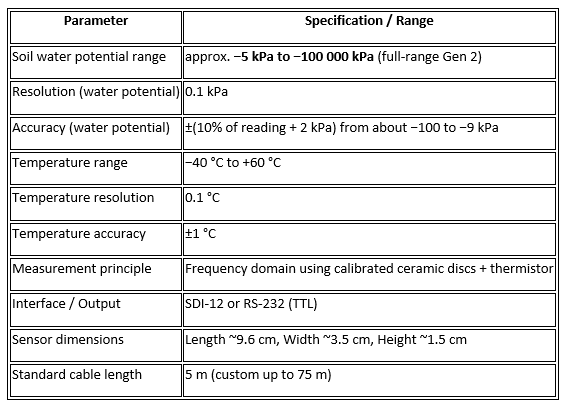
- • Wide measurement range from near saturation up to very dry (on the order of −100 000 kPa in certain versions) allowing monitoring from wet to practically air dry soils.
- • Accuracy in the core range: ±(10% of reading + 2 kPa) from about −100 to −9 kPa.
- • Resolution: 0.1 kPa in water potential measurements.
- • Built in temperature sensor: range −40 °C to +60 °C, resolution 0.1 °C, accuracy ±1 °C.
- • Low sensitivity to soil salinity (important for soils with variable salts) and no need for regular recalibration.
- • Compatible with standard data loggers (e.g., SDI 12 protocol) and long cable lengths (standard 5 m, up to 75 m) for flexible installations.
- • Durable design: epoxy encapsulated, suitable for long term installations in field conditions.
Technical Specifications
Applications / Usage Areas
- • Field monitoring of soil moisture/availability for irrigation management in agriculture and horticulture.
- • Soil science and hydrology: measurement of matric potential rather than just moisture content gives deeper insight into soil water movement, retention and availability.
- • Environmental and geotechnical monitoring: e.g., monitoring of soil suction, unsaturated zone behaviour, drainage and recharge.
- • Research installations: long term deployment in different soil types, varying salinity, and remote monitoring setups.
- • Precision agriculture: optimize irrigation scheduling by knowing more than just “how much water is there” — but “how available is it, and where is movement/flux likely to occur”.
User Benefits
- • More meaningful measurement for plant available water and water flux dynamics than simple volumetric sensors.
- • Long term, low maintenance installation: less upkeep, no need for frequent recalibration.
- • Compatible with digital logging and telemetry systems — easy integration into modern monitoring/IoT frameworks.
- • Durable build suitable for field conditions rather than fragile lab only sensors.
- • Provides consistent comparison across soil types because matric potential depends less on soil texture.
Considerations / Best Practice
- • While the range is very wide, accuracy beyond about −100 kPa is not guaranteed to the same specification, so for extremely dry soils you may want to check calibration/documentation.
- • Sensor installation: ensure good soil contact around the ceramic disc, proper depth, avoidance of large air gaps or disturbed soil that may affect equilibration.
- • Temperature effects: while the sensor includes temperature measurement, extremes of soil freezing or large temperature gradients may influence response time and accuracy.
- • Interpretation: too much data but with poor context can confuse — matric potential is very useful but must be used alongside other soil/crop information (e.g., root zone depth, soil texture, plant uptake).
- • Logger compatibility: make sure your data logger or system supports SDI 12 or RS 232 and the correct sensor excitation voltage (3.6 15 V) as specified.



 CALL US
 WHATSAPP
 LOCATION