TEROS 06 Soil Temperature Profile Probe
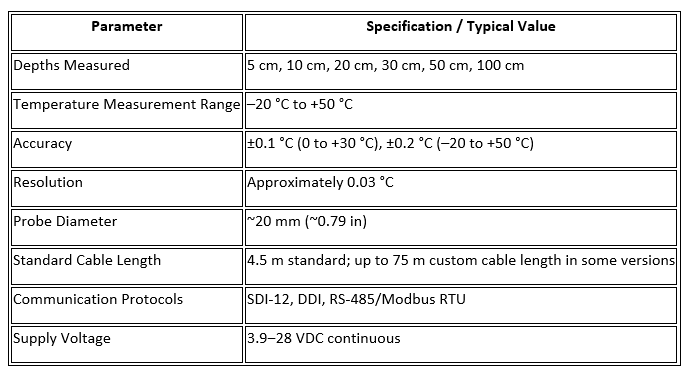
The TEROS 06 is a research-grade soil temperature profile probe designed to measure and log soil temperature across a complete soil profile at six discrete depths. According to the manufacturer, it exceeds World Meteorological Organization (WMO) recommended depths by offering measurement points at 5 cm, 10 cm, 20 cm, 30 cm, 50 cm and 100 cm.
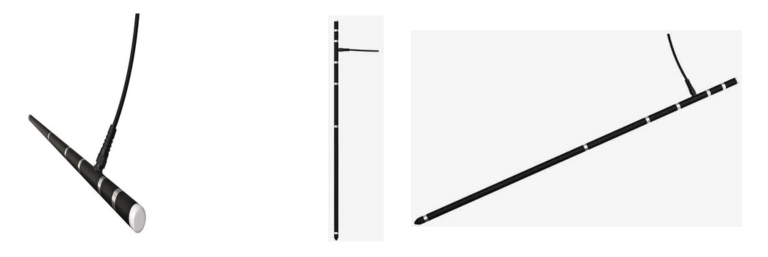
With a small diameter (≈20 mm) to minimize soil disturbance and a low thermal-conductivity rod body (fiberglass reinforced plastic) to reduce heat transfer between layers, the TEROS 06 ensures that each depth reading is accurate and independent. Metal (stainless steel) rings at each depth provide good thermal contact with the surrounding soil.
Perfect for field installation, lysimeters, long-term monitoring of soil temperature dynamics, agriculture research, environmental studies and energy-balance modelling.
Key Feature
- • Six depth measurement points: 5 cm, 10 cm, 20 cm, 30 cm, 50 cm, 100 cm – giving a full profile of soil temperature.
- • High precision: each sensor calibrated individually, accuracy ±0.1 °C (in the range 0-30 °C) and ±0.2 °C for –20 to +50 °C.
- • Minimal disturbance installation: 20 mm diameter probe body and engineered design to suppress inter-layer heat transfer.
- • Digital output, compatible with SDI-12, DDI, RS-485/Modbus protocols for easy data-logging and telemetry integration.
- • Plug-and-play design: easily integrated with METER’s ZL6 data logger or other compatible systems for remote monitoring and cloud connectivity.
Technical Specification
Application
- • Soil temperature monitoring for agriculture: root zone dynamics, crop performance, thermal stress.
- • Environmental/meteorological studies: soil heat flux, energy balance, climate response modelling.
- • Hydrology and ecosystem research: analysing soil thermal profiles, freeze/thaw events.
- • Lysimeter installations and field-trial monitoring: integration into multi-parameter systems.
- • Remote monitoring networks: coupling with dataloggers and cloud platforms for live data access.
Benifits /User Advantages
- • Comprehensive profile temperature data from one instrument – fewer sensors needed per site.
- • High accuracy and low disturbance ensure that the measurement reflects true soil temperature rather than artifacts.
- • Digital integration simplifies data collection and remote monitoring, reducing manual work.
- • Durable, long-term field design suitable for research/industrial deployments.
- • Enhances decision-making: understanding soil thermal regimes helps irrigation scheduling, crop management, energy modelling.
Best Practices & Considerations
- • Installation depth & location: Choose site free of large rocks or roots, drill or auger to correct depth, use the recommended auger for the TEROS 06.
- • Ensure good thermal contact: The stainless steel rings and shaft must be in close soil contact; avoid creating air-gaps or preferential thermal paths.
- • Cable routing & protection: Bury cable/trench or protect to avoid damage, rod influence or heating from surface.
- • Use compatible logger/software: Configure SDI-12/DDI output correctly, check firmware and logger settings before deploying.
- • Check calibration & maintenance: Although factory calibrated, periodically verify sensor functionality especially if installed long-term or under harsh conditions.
- • Interpret data properly: Soil temperature is influenced by solar radiation, moisture, soil type and depth – contextualise the readings with other parameters like moisture, heat flux if needed.



 CALL US
 WHATSAPP
 LOCATION