Soil Water Wet Sieving Apparatus
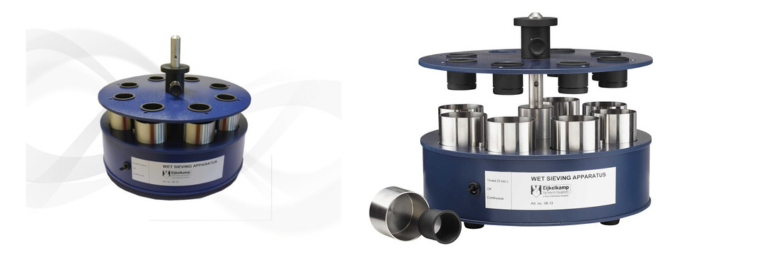
The Soil Water Wet Sieving Apparatus is a laboratory instrument designed for the particle size analysis of soil aggregates under wet conditions. Unlike dry sieving, wet sieving allows accurate determination of soil structure and aggregation, which is critical for understanding soil stability, erosion potential, water infiltration, and root penetration.
Key Feature /Highlights
- • Constructed from durable stainless steel and corrosion-resistant materials suitable for repeated wet operations.
- • Includes stackable sieves with varying mesh sizes for flexible particle size analysis.
- • Mechanical oscillation or vibration mechanism ensures uniform wet sieving without manual bias.
- • Equipped with a water spray system for gentle dispersion of aggregates and preventing damage.
- • Transparent collection trays or containers for easy observation and sample collection.
- • Can be integrated with digital weighing systems for precise mass measurement before and after sieving.
- • Complies with standard protocols for water-stable aggregate analysis (e.g., USDA, ISO, ASTM standards).
Technical Specification

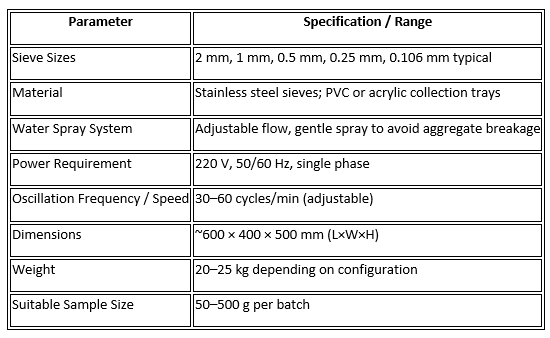
Application /Usage Areas
- • Soil Science & Agronomy: Measure water-stable aggregates to understand soil structure, porosity, and compaction effects.
- • Environmental Studies: Assess soil erosion risk, stability, and sediment transport potential.
- • Civil & Geotechnical Engineering: Evaluate aggregate stability for foundations, embankments, and slope management.
- • Research & Education: Laboratory experiments in soil mechanics, hydrology, and sustainable land management.
Benefits /User Advantages
- • Accurate & reproducible wet aggregate size analysis.
- • Reduces manual labor with mechanical wet sieving system.
- • High durability stainless steel and corrosion-resistant components for long-term use.
- • Flexible configuration: compatible with multiple sieve sizes and sample volumes.
- • Standard-compliant: suitable for use in research labs following international soil stability methods.
Best Practice & Considerations
- • Ensure soil samples are properly pre-wetted before wet sieving to avoid clumping or breaking aggregates.
- • Avoid excessive water spray pressure to prevent disintegration of naturally stable aggregates.
- • Clean sieves thoroughly after each use to prevent cross-contamination between samples.
- • Use standardized weighing scales to maintain accuracy in mass measurement before and after sieving.
- • For very fine soils (<0.1 mm), consider additional suspension separation or sedimentation techniques for accurate size distribution.
- • Calibrate oscillation speed and water flow to suit soil type and moisture content.



 CALL US
 WHATSAPP
 LOCATION