Soil Moisture Tensiometer
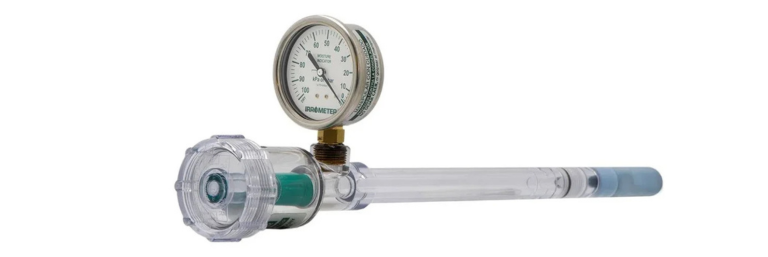
The Soil Moisture Tensiometer is a reliable field instrument for measuring the matric potential (soil water tension) in unsaturated soils. It consists of a water filled tube with a porous ceramic cup at the lower end, installed at a selected depth in the soil. As the plant or soil system extracts water, suction is created and transmitted to the gauge. The tensiometer reading indicates how strongly water is held in the soil matrix and thus guides irrigation decisions, soil health assessment, and research into soil plant water relationships.
Used commonly in agriculture, horticulture, turf management, environmental and soil science research, the tensiometer provides direct measurement of soil water potential and is unaffected by soil electrical conductivity or salinity.
Key Features
- • Measures soil water tension (suction) directly, providing a meaningful indicator of plant available water and soil moisture status.
- • Porous ceramic cup provides hydraulic contact with the soil; water moves in or out of the cup until equilibrium with surrounding soil moisture tension is achieved.
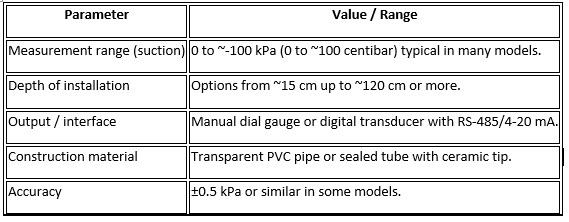
- • Manual gauge or digital transducer depending on model; some versions include RS 485/4 20 mA output for data logging and telemetry.
- • Suitable for installation at varying depths (e.g., 15–120 cm) to monitor root zone moisture conditions, in fields, orchards, vineyards, greenhouses or research plots.
- • Robust and long term field usage: minimal calibration required, unaffected by soil salinity or fertilizers.
Technical Specification

Application
- • Agriculture & Irrigation Management: Monitor root zone soil moisture tension and determine optimal irrigation timing, avoiding over or under watering.
- • Horticulture / Greenhouse: Especially in drip irrigated or high value crops where accurate moisture scheduling is important.
- • Soil Science & Environmental Research: Track matric potential changes, study soil plant water relations, solute transport, and moisture dynamics.
- • Turf & Landscape Management: Use in sports fields, lawns or ornamental plantings to monitor root zone moisture tension and schedule water accordingly.
- • Automated Monitoring Systems: Many tensiometers integrate with data loggers or telemetry to automate irrigation based on real time tension readings.
Benefits To Users
- • Provides real time, direct insight into soil water status in terms of suction, which is closely related to what plants experience.
- • Helps conserve water by enabling data driven irrigation scheduling.
- • Durable and simple to install and maintain; low ongoing calibration maintenance burden.
- • Unaffected by soil salinity (unlike some volumetric sensors) and offers long term reliability in field settings.
- • Integration with monitoring systems enables smarter farm/field management and improved crop health outcomes.
Best Practice Consederations
- • Install the porous ceramic tip at depth corresponding to the active root zone and wet soil profile; avoid placing in too dry or isolated soil zones.
- • Ensure good hydraulic contact between the soil and the ceramic cup—loose soil, air gaps or improper installation can cause inaccurate readings.
- • For soils with very high suction (very dry, fine textured soils) tensiometers may cease to function (air enters the system) beyond ~100 centibar (~100 kPa) typical in high clay soils.
- • Protect the instrument from freezing, strong sunlight, and ensure regular checking of water column and air bubbles.
- • While tensiometer reading gives suction, translating that into volumetric water content requires calibration for specific soil types; ideal for tension monitoring rather than direct moisture content.



 CALL US
 WHATSAPP
 LOCATION