Soil Moisture Meter (Profile Probe)
The Soil Moisture Profile Probe is an advanced multi depth instrument designed to monitor volumetric water content (VWC) and optionally temperature across multiple layers of the soil profile. It enables continuous, in situ measurement of moisture dynamics at various depths — instead of a single point — thereby giving a true picture of how water moves through the soil column. For example, the GroPoint Profile Probe uses TDT⁵ (Time Domain Transmission) technology, and is available in lengths up to ~120 cm (≈48″), divided into 15 cm (≈6″) segments.
This makes the probe ideal for precision agriculture, irrigation scheduling, environmental monitoring, research plots and commercial fields where knowing the moisture status at root zone and below is crucial.
Key Feature /Highlights
- • Multi segment sensor design (e.g., 15 cm segments) allows monitoring of moisture at multiple depths in one probe.
- • Integrated soil temperature sensors (optional) at set intervals for combined moisture/temperature profiling.
- • Digital output via SDI 12, optionally RS 485/Modbus in some models — simplifies integration with dataloggers and telemetry.
- • Factory calibration for many soil types, with custom calibration options for specific conditions (saline soils, very coarse media) for improved accuracy.
- • Minimal soil disturbance installation: many models use insertion tools, do not require large excavations or access tubes.
- • Low power, robust field design suited for long term deployment in agricultural or environmental settings.
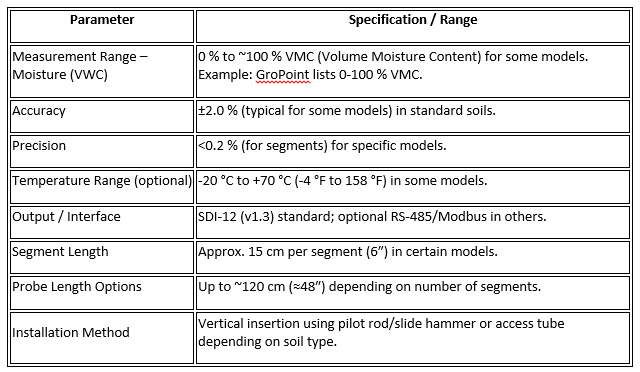
Technical Specification
Application/Usage Areas
- • Precision agriculture & irrigation: Monitor soil moisture at different depths to optimise irrigation scheduling, reduce water waste, and maximise crop yield.
- • Environmental & hydrology research: Track moisture dynamics through the soil profile, study infiltration, drought/wet period responses, land/atmosphere interactions.
- • Horticulture & orchards: Installing in root zone profiles of tree crops or vines to monitor sub surface moisture for drip or micro irrigation systems.
- • Soil science & research: Evaluate soil water retention, profile moisture change over time and across layers, and calibrate models.
- • Remote monitoring & IoT deployments: Integration with telemetry systems for remote fields, greenhouses, or large scale installations.
Benefits /User Advantages
- • More representative data: Multi depth measurements give a fuller picture of moisture distribution than single point sensors.
- • Time & labour efficient: One probe covers multiple depths; less wiring and fewer sensors needed compared to installing individual sensors at each depth.
- • Data rich: Enables trend analysis, root zone water extraction monitoring, and better decision support for irrigation/fertilisation.
- • Flexible and robust: Designed for in field deployment, built for durability and low maintenance use.
- • Compatible with modern data systems: Digital output, easy integration, supports research and commercial applications alike.
Best Practice & Considerations
- • Ensure proper installation: Good soil sensor contact is essential; avoid air gaps or disturbed soil around the probe. Some models recommend pilot rod insertion to minimise disturbance.
- • Choose the correct depth and number of segments: Align the probe length/segments with your root zone or the soil depth of interest.
- • Understand calibration and soil type: If soil is unusual (very high clay, organic matter, saline), consider custom calibration to improve accuracy.
- • Protect the cable and connectors: In field installation, shield from mechanical damage, rodents, or grinding equipment.
- • Integrate with logger/telemetry properly: Use SDI 12 or RS 485 compatible dataloggers; ensure power supply, logger sampling interval and data handling are set up correctly.
- • Maintenance and verification: Periodically check the sensor, clean the surface if needed, compare with gravimetric checks or known moisture states for quality control.
- • Interpret data in context: Moisture values can vary with soil texture, bulk density, root uptake; use values as part of a broader decision support system rather than stand alone.



 CALL US
 WHATSAPP
 LOCATION