Soil Hydrometers
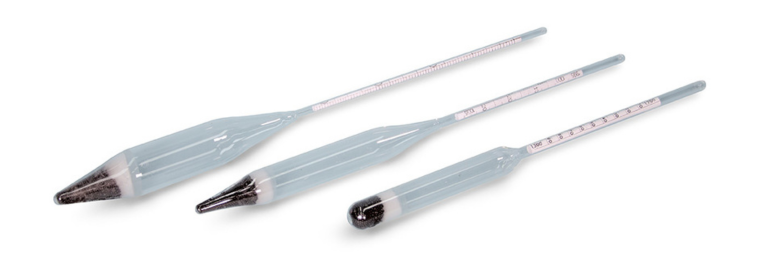
A soil hydrometer is a laboratory instrument used to determine soil particle-size distribution, specifically the proportion of silt and clay in a soil sample. This is done through hydrometer analysis, which measures the rate at which soil particles settle in a water column following Stokes’ Law. Hydrometers provide readings of suspension density or specific gravity over time, allowing calculation of particle size fractions finer than 0.075 mm (No. 200 sieve).
Soil hydrometers are essential in soil physics, geotechnical engineering, agronomy, and sedimentology where accurate textural classification (sand–silt–clay ratios) is required.
Key Features
- • Measures fine particle fractions (silt & clay) not captured by sieving alone.
- • Standardized scale (Bouyoucos or ASTM) for direct reading of suspension density.
- • Clear, accurate glass construction for reliable meniscus readings.
- • Compatible with standard sedimentation cylinders (1 L or 1000 mL).
- • Used with dispersing solutions to ensure proper particle separation.
Typical Types of Soil Hydrometers
1. ASTM Soil Hydrometer (152H / 151H)
- • Scale: Specific gravity of soil suspension.
- • Common in geotechnical engineering labs.
- • Standardized for ASTM D422 / D7928 hydrometer analysis
2. Bouyoucos Soil Hydrometer
- • Scale: Grams of soil in suspension per liter of water.
- • Common in agricultural soil science and texture estimation.
- • Often paired with the Bouyoucos method for soil texture.
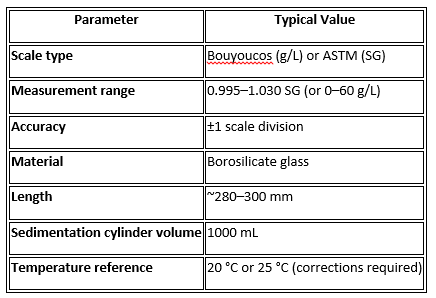
Technical Specifications (Typical)
How It Works
- 1. Soil is dispersed in water using a dispersant (e.g., sodium hexametaphosphate).
- 2. The suspension is mixed thoroughly.
- 3. The hydrometer is lowered into the cylinder at specific time intervals.
- 4. As particles settle, the suspension becomes less dense.
- 5. The hydrometer reading decreases over time, allowing calculation of particle settling velocity.
- 6. Using Stokes’ Law, the corresponding particle sizes are derived.
Applications
- • Determining soil texture (USDA or FAO triangle)
- • Evaluating erosion risk and particle transport
- • Geotechnical classification (Unified Soil Classification System)
- • Sedimentology and water-quality studies
- • Agricultural soil management and nutrient retention analysis
Benefits to Users
- • Provides detailed fine-fraction analysis beyond sieve limits.
- • Inexpensive and widely used in both teaching and professional labs.
- • Core method for soil classification and engineering design.
- • Gives highly repeatable results when performed using standard procedures.
Best Practices / Considerations
- • Ensure temperature corrections are applied — suspension density changes with temperature.
- • Proper dispersing and mixing are essential to avoid particle flocculation.
- • Avoid air bubbles on the hydrometer, which can distort readings.
- • Take readings at eye level and use the top of the meniscus when instructed.
- • Record time precisely — settling time directly affects calculated particle size.



 CALL US
 WHATSAPP
 LOCATION