Plant Canopy Analyser
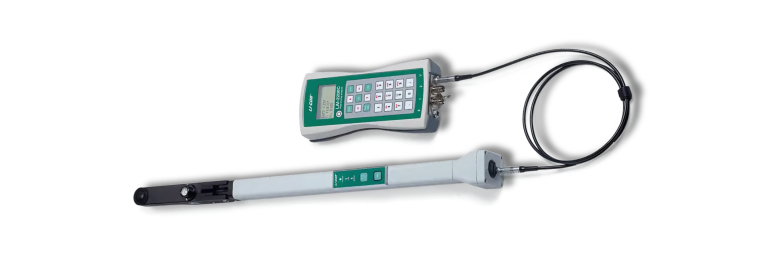
The Plant Canopy Analyzer (LP-80) is a precision, non-destructive instrument for measuring Leaf Area Index (LAI), canopy light interception, and Photosynthetically Active Radiation (PAR) directly in the field.
It uses a quantum-sensor array to determine how much light penetrates the plant canopy, delivering accurate values for LAI, fPAR, and canopy extinction coefficient (k).
Lightweight, battery-operated, and equipped with an internal computation unit, the LP-80 enables real-time canopy analysis without sample removal—ideal for agricultural, forestry, and ecological research.
Features
- Non-destructive measurement of LAI and PAR for crops, forests, and grasslands.
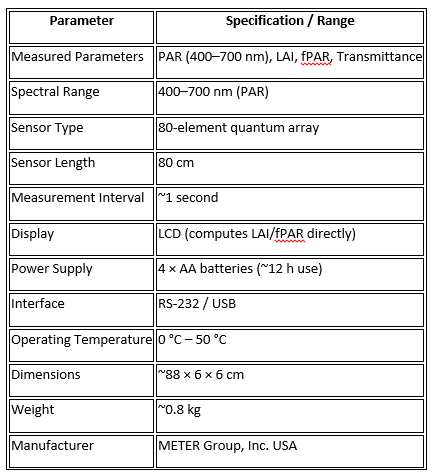
- Integrated 80-element quantum sensor array (400–700 nm PAR range).
- Calculates LAI and fPAR instantly with built-in microprocessor.
- Automatic cosine correction ensures precision under varying sunlight angles
- Compact and lightweight (0.8 kg) — ideal for field deployment.
- Powered by 4 × AA batteries, ~12 h continuous use.
- USB/RS-232 connectivity for data download.
- Weather-resistant housing for rugged field conditions
Technical Parameters
Applications / Usage Areas
- Agriculture: Crop growth analysis, canopy closure, yield estimation.
- Forestry: Forest canopy density and light penetration measurement.
- Environmental Monitoring: Vegetation cover and climate model studies.
- Irrigation Management: Optimize water usage using canopy coverage data.
- Education & Research: Demonstrations of light–plant interaction dynamics.
Benefits / User Advantages
- Instant, non-destructive canopy analysis — no plant cutting.
- Precise, reliable results under diffuse or shaded conditions
- Compact and user-friendly for field deployment.
- Compatible with data loggers and analysis software
- Reduces manual data handling with onboard computation.
Best Practices & Considerations
- Take above-canopy references before and after below-canopy readings.
- Perform measurements under diffuse light (morning/evening/overcast).
- Keep sensor array clean and level.
- Avoid strong direct sunlight during readings.
- Regular calibration recommended for research-grade accuracy.


 CALL US
 WHATSAPP
 LOCATION