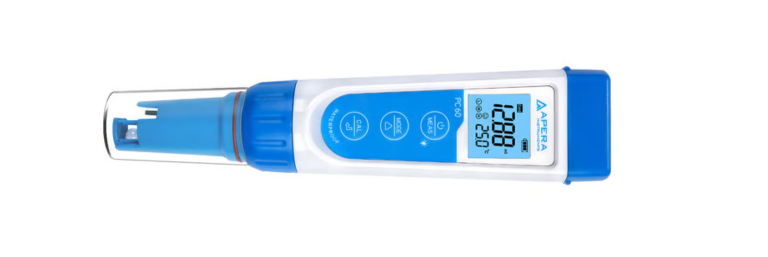
PC 60 Multiparameter Pocket Tester
The PC60 Premium Pocket Tester is a professional-grade, rugged, all-in-one handheld instrument designed for quick, accurate and reliable water-quality testing. With the capability to measure pH, electrical conductivity (EC), total dissolved solids (TDS), salinity, and temperature, the PC60 is ideal for environmental monitoring, aquaculture, hydroponics, water treatment, labs, and field work. The device comes with a replaceable multi-parameter probe, a dual-display back-lit large screen, automatic temperature compensation (ATC), and a rugged, waterproof IP67-rated housing that even floats. The complete kit includes calibration solutions, storage solution, batteries and carrying case — ready to use out-of-the-box.
Key Feature/ Highlights
- • 5-in-1 measurement: pH, EC, TDS, Salinity & Temperature.
- • Replaceable multi-parameter probe, enabling seamless switching between measurement modes.
- • Large LCD display with dual (or multi) back-lit colours for measurement mode vs calibration mode (blue/green) and dual display of parameter + temperature.
- • Automatic buffer recognition calibration (1- to 3-point) for pH & EC modes.
- • Auto Temperature Compensation (ATC) from 0 °C to 50 °C (32-122 °F) for high accuracy across typical ambient and sample conditions.
- • Rugged waterproof & dustproof housing with IP67 rating — safe for field use, even floatable.
- • Auto-Hold / stable reading recognition with “smiley face” icon for usability in the field.
- • Complete kit: included calibration solutions, storage solution, batteries (4× AAA), lanyard, carry case — ready for deployment.
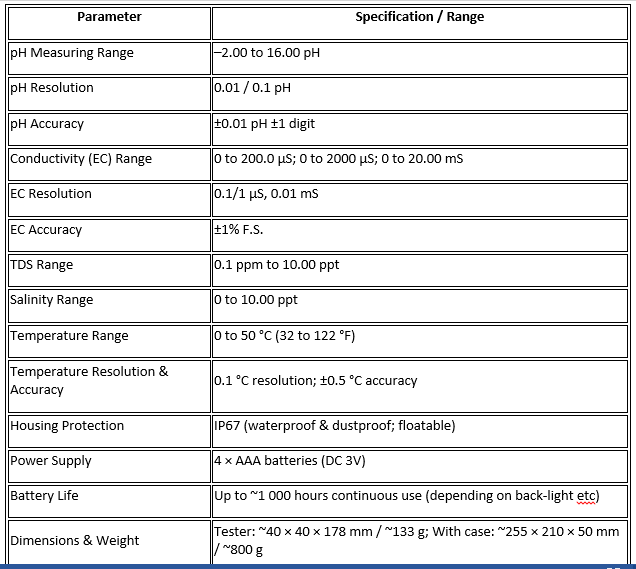
Technical Specification
Applications / Usage Areas
- • Water quality testing: drinking water, pools & spas, aquaculture systems, hydroponics, water-treatment plants.
- • Environmental monitoring: rivers, lakes, groundwater, storm-water run-off, soil-water interface (with appropriate probes).
- • Industrial process waters: cooling towers, boilers, wastewater, chemical process monitoring.
- • Research & education: labs needing multi-parameter handheld meter for field or bench work.
- • Agriculture/horticulture: nutrient solution monitoring in hydroponics, fertigation, salinity control.
Benifits/User Advantages
- • Combines multiple measurement capabilities (pH, EC, TDS, salinity, temperature) into a single compact instrument — saves cost, space and time.
- • Field-rugged design (IP67, floatable) ensures reliability in challenging environments, reducing downtime and risk.
- • Simple, intuitive user interface with large back-lit display, auto-hold and stability indicators — less user error, faster measurements.
- • Replaceable probe extends life of instrument and allows flexibility if sample types vary.
- • Complete kit means you can deploy immediately — no need to source calibration supplies separately.
- • Wide operating range, high accuracy and auto temperature compensation make it suitable for professional, demanding applications.
Best Practice & Consideration
- • To maintain accuracy, regularly calibrate the meter (1- to 3-point as supported) and rinse the probe between samples to avoid cross-contamination or measurement drift.
- • Although the kit supports wide range, ensure the sample falls within the measurement ranges (e.g., extremely high salinity beyond 10 ppt may require specialized meter).
- • For the probe’s longevity: store according to manufacturer’s recommendations (usually in the storage solution provided, not in pure/distilled water) and avoid extreme temperatures when in use or storage.
- • When measuring small volumes or viscous solutions, ensure sufficient immersion and stirring so the probe sensor is properly exposed and equilibrated.
- • Battery life depends on usage (back-light, field conditions) — carry spare AAA batteries especially for field deployments.
- • Although rugged, avoid dropping the instrument from large heights; even floatable meters must be handled with care to protect the probe and housing seals.


 CALL US
 WHATSAPP
 LOCATION