Guelph Permeameter
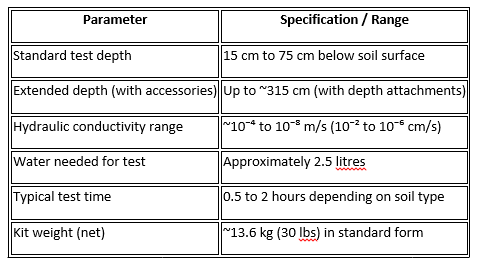
The Guelph Permeameter is a field-portable, constant-head well permeameter designed to measure in-situ soil hydraulic conductivity, soil sorptivity, and matrix flux potential in unsaturated soil zones. It uses the Mariotte (constant-head) principle: a water reservoir maintains a steady head in a borehole, and the flow rate into the surrounding soil is measured. Because the measuring set is compact, it can be transported and operated by a single technician, typically delivering results in ½ to 2 hours using only about 2.5 litres of water.
It is especially useful in agricultural, environmental monitoring, irrigation/drainage planning, soil physics research and geotechnical investigations where knowing how quickly water moves through the soil is critical.
Key Features / Highlights
- • Utilises the “constant-head well” technique for field measurements of hydraulic conductivity, sorptivity and flux potential.
- • Lightweight, portable kit designed for one-person operation in the field.
- • Requires only minimal water supply (approx. 2.5 litres) and short measurement time (½ to 2 hours depending on soil).
- • Supports measurements at depths from ~15 cm to 75 cm in standard mode, and with extension kits up to ~315 cm in some models.
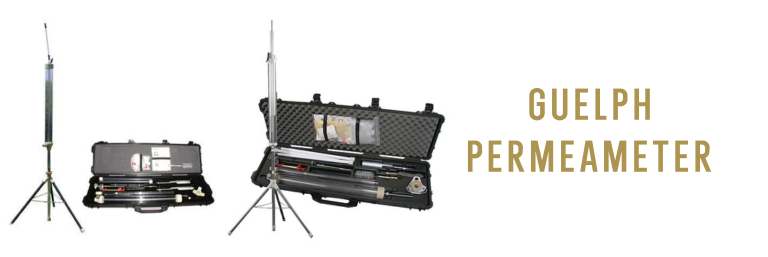
- • Robust construction with accessories including tripod, well auger, preparation tools, collapsible water container, vacuum test pump, carrying case.
Technical Specifications
Applications / Usage Areas
- • On-site measurement of soil saturated hydraulic conductivity and flux potential for agricultural irrigation/drainage management.
- • Soil physics and hydrology research: quantifying water movement through soil in field conditions.
- • Environmental & geotechnical projects: evaluating soil permeability for landfills, infiltration basins, recharge zones.
- • Soil and water management: determining suitability of soils for infiltration, drainage, or as a liner.
Benifits To Users
- • Provides field-based, rather than lab-only, measurement of hydraulic properties – yielding real-world soil conditions.
- • Fast turnaround (within hours) allows more measurement points and better spatial coverage.
- • Minimal water usage and portable kit enables usage in remote or constrained areas.
- • Helps inform design decisions (irrigation, drainage, infiltration) based on actual measured soil behaviour rather than estimates.
Considerations / Best Practice
- • Ensure borehole is properly prepared (clean auger hole, minimal disturbance) for accurate flow measurement.
- • Install in unsaturated zone above groundwater table (as designed) to avoid saturation bias.
- • Use appropriate depth attachments and accessories if measurement deeper than standard range is needed.
- • Interpret results taking into account soil texture, moisture conditions, and field heterogeneity.
- • Regularly inspect and maintain kit’s seals, valves, and water reservoir for reliability.



 CALL US
 WHATSAPP
 LOCATION