Capacitive TDR Soil Moisture Sensors
A TDR (Time Domain Reflectometry) Soil Moisture Sensor is an advanced instrument used to measure the volumetric water content (VWC) of soils by sending a short electromagnetic pulse along waveguides (rods) embedded in the soil, and measuring the travel time or reflection of that pulse. The dielectric permittivity of soil changes significantly with water content, so this method enables accurate, non destructive measurement of soil moisture under a wide range of conditions.
These sensors are ideal for agriculture, irrigation management, environmental monitoring, and research applications where precise soil water data is required. They offer high accuracy, fast response, and stability across different soil types and salinity levels.
Key Features /Highlights
- • High precision TDR technology enabling accurate volumetric water content measurement.
- • Large sampling volume using extended waveguides (rods) to reduce local variability and improve representativeness.
- • Suitable for multiple soil types, including mineral, sandy, and soilless media — some models include dielectric and bulk EC measurement.
- • Real time or near real time monitoring capability, with digital outputs compatible with dataloggers (SDI 12, RS 485, etc.).
- • Robust design for field deployment: durable rods, weatherproof housing, wide temperature range.
- • Low maintenance and long service life — ideal for long term monitoring installations.
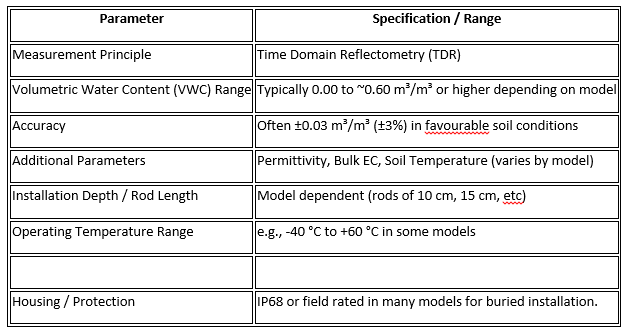
Technical Specification
Application/Usage Areas
- • Agriculture / Precision Irrigation: Monitoring root zone moisture to optimise irrigation scheduling, reduce water waste and increase crop yield.
- • Environmental & Hydrology Monitoring: Studying soil moisture dynamics, infiltration, watershed behaviour, drought monitoring.
- • Research & Soil Science: Soil moisture profiling, multi depth installation, long term field experiments.
- • Greenhouses / Horticulture / Soilless Media: With appropriate probes, measurement in rock wool, peat, hydroponic setups.
- • Infrastructure / Landscaping / Turf Management: Soil moisture monitoring in sports turf, green roofs, golf courses, landscaping.
Benifits/User Advantages
- • High accuracy and resolution: more dependable data for decision making compared to simpler moisture sensors.
- • Non destructive, in situ installation: sensors can be left in situ for long periods with minimal disturbance.
- • Multi parameter capability (some models): measuring not just moisture but temperature, EC, etc.
- • Real time monitoring & data logging: enable automation, remote telemetry and integration into IoT systems.
- • Suitable for long term deployment: robust design means less maintenance, fewer replacements.
- • Versatility: models available for shallow soil installations, deep profiles, multiple depths, so scales from small research plots to large field installations.
Best Practices & Considerations
- • Ensure good soil contact: avoid air gaps between waveguides and soil—air gaps significantly affect measurement.
- • Select the correct probe length and model for your application: shallow vs deep, single depth vs profile, soil vs soilless media.
- • Calibration: although many TDR sensors are factory calibrated for mineral soils, if you’re working with highly textured soils, organic soils or soilless media, consider site/soil specific calibration.
- • Wiring & installation: ensure cables are protected, sensor is installed at desired depth/angle, avoid damage to rods.
- • Data logger compatibility: check output format (SDI 12, RS 485, etc) and ensure your acquisition system can read the sensor.
- • Maintenance & longevity: periodically check condition of rods, housing, connections; burying sensors means retrieval can be hard—plan accordingly.
- • Interpretation: understand that VWC readings may need to be interpreted in context of soil type, texture, bulk density and to integrate with other data (soil water potential, irrigation input, etc).



 CALL US
 WHATSAPP
 LOCATION