Flumes
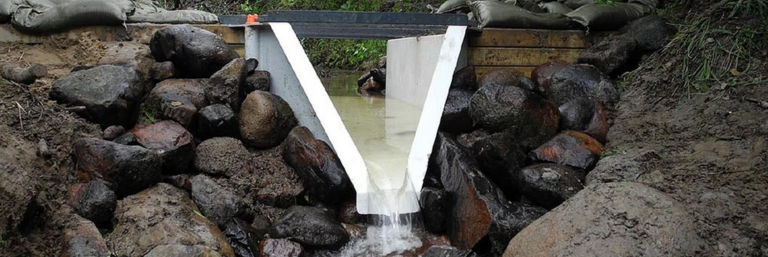
A flume is a specially shaped, fixed hydraulic structure used to measure flow in open channels or streams. Unlike weirs, flumes do not create a sharp overflow; instead, they accelerate water through a constricted section, where the flow velocity and water depth are related to discharge.
Flumes are widely used in water resources management, irrigation systems, wastewater treatment, hydrology studies, and environmental monitoring. They are particularly useful for high flow rates or debris-laden water, where weirs may clog or be less accurate.
Key Features
- • Flow measurement is based on channel geometry and water depth (head).
- • Can handle high sediment or debris content better than weirs.
- • Variety of shapes: Parshall, trapezoidal, cutthroat, Palmer–Bowlus, H flume, and Montana flumes.
- • Minimal head loss; suitable for situations where downstream water levels must remain stable.
- • Can be used with pressure transducers, water level loggers, or 4 20 mA sensors for automated data acquisition.
- • Can accommodate both small channels and large rivers.
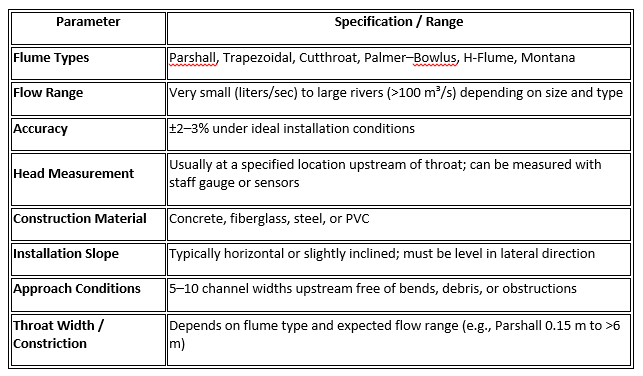
Technical Specifications (Typical / Example)
Applications
- • Irrigation Systems: Flow monitoring in canals and distributaries.
- • Wastewater Treatment Plants: Monitoring effluent and process flows.
- • Hydrology / Streamflow Gauging: Measuring rivers, streams, or stormwater outfalls.
- • Industrial Discharges: Monitoring process water or effluent flows.
- • Research / Environmental Studies: Small flumes for lab flume experiments and field flow studies.
Benefits to Users
- • High accuracy: Especially under free-flowing, properly installed conditions.
- • Handles debris & sediment: Less prone to clogging compared to weirs.
- • Low maintenance: No moving parts, minimal cleaning required.
- • Wide flow range: Can measure very low to very high flows depending on flume size.
- • Flexible design: Many standard shapes with published calibration tables.
- • Integratable: Works with sensors like pressure transducers, water-level loggers, or 4–20 mA devices for automated flow monitoring.
Best Practices / Considerations
- • Free Flow Requirement: Ensure downstream water does not back up into the flume; otherwise, flow equations are invalid.
- • Straight Approach Channel: 5–10 channel widths upstream free of bends, obstructions, and turbulence for accurate readings.
- • Calibration & Standard Tables: Use manufacturer or published calibration tables for your flume type and size.
- • Structural Integrity: Properly anchor and support flume to prevent movement or scour.
- • Sediment / Debris Management: Periodic inspection is required in channels with high debris or sediment loads.
- • ensor Placement: For automated flow monitoring, place water level sensors in the specified head location (usually upstream of throat) in a stilling well or protected side channel.
- • Slope & Alignment: Flume must be level laterally and installed at recommended slope for accurate flow measurement.



 CALL US
 WHATSAPP
 LOCATION