FLOW PROBE
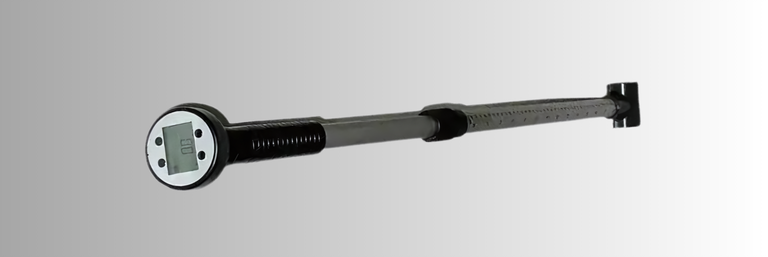
A Flow Probe is a handheld instrument used to measure water velocity in open channels, streams, pipes, irrigation canals, and environmental monitoring sites. It typically consists of a telescoping rod with a protected propeller sensor (or electromagnetic sensor) at the end. The probe measures point velocity, which can be used to calculate discharge (flow rate) when combined with channel cross-section data.
Flow probes are widely used in hydrology, stormwater management, agricultural water distribution, wastewater monitoring, and environmental field studies.
Key Features
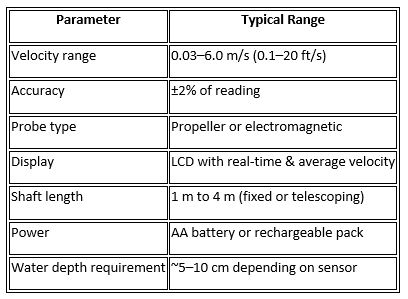
- • Direct reading of water velocity (often 0.1–20 ft/s or 0.03–6 m/s).
- • Telescoping handle for reaching into channels or culverts.
- • Protected propeller or EM sensor prevents debris interference.
- • Digital display showing real-time velocity, average velocity, and sometimes temperature.
- • Durable, waterproof construction for field use.
- • Low power operation (often AA batteries).
Common Types
1. Propeller Flow Probe (Most Common)
- • Small, multi-bladed rotor encased in a cage
- • Measures velocity via rotational speed
- • Good for streams, culverts, irrigation channels
2. Electromagnetic (EM) Flow Probe
- • No moving parts
- • Measures velocity using induced voltage in conductive water
- • Excellent for low-flow, debris-rich, or shallow water
3. Ultrasonic Flow Probe
- • Specialized instruments for pipe flow or large channels
- • Uses transit-time or Doppler ultrasound
Typical Specification
Applications
- • Stream and river flow studies
- • Irrigation canal monitoring
- • Drainage and stormwater system assessments
- • Environmental surveys and field hydrology
- • Wastewater treatment & industrial effluent monitoring
- • Culvert and pipe velocity measurement
Benefits to Users
- • Fast, portable, accurate velocity measurements
- • No need for large instruments or flow meters
- • Works in shallow or irregular channels
- • Rugged and suitable for field environments
- • Can be used to calculate stream discharge with cross-section data
Best Practices / Considerations
- • Take multiple depth measurements to compute average velocity (e.g., 0.4 depth, 0.6 depth).
- • Keep the probe aligned directly with flow direction.
- • Avoid contacting channel bed — can affect readings.
- • For low-clearance flows, EM probes are better than propeller probes.
- • Clean the sensor after use in sediment-heavy or debris-filled water.



 CALL US
 WHATSAPP
 LOCATION