DIGITAL WATER LEVEL LOGGER PRESSURE TRANSDUCER
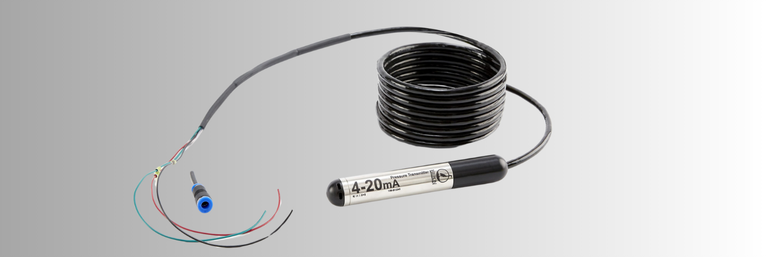
The Pressure Transmitter is a continuous, submersible pressure sensor designed for real time water-level monitoring. Unlike a data logger, it does not store data internally — instead, it outputs a 4 20 mA current loop signal that can be fed into SCADA systems, PLCs, telemetry units, or third party data loggers and displays.
It operates on a two-wired system, making installation relatively simple, and uses a vented cable option to allow barometric compensation for more accurate level readings.
Key Features
- • Continuous, real-time water level / pressure measurement.
- • 2-wire 4 20 mA current loop output — industry standard, good for long distance signal transmission.
- • Vented cable option to provide real-time barometric compensation, improving measurement accuracy.
- • Wide supply voltage range: 7.5 VDC to 35 VDC.
- • Reverse-polarity protection – helps prevent damage during wiring errors.
- • High noise immunity over long cable runs.
- • Robust, corrosion resistant construction (wetted parts in SS + Delrin).
- • Several pressure (level) ranges available (10 m, 30 m, 60 m, 120 m).
- • Compact form factor, making it easy to deploy in wells, boreholes, or tanks.
Technical Specification
Here are detailed specs based on manufacturer and distributor datasheets:
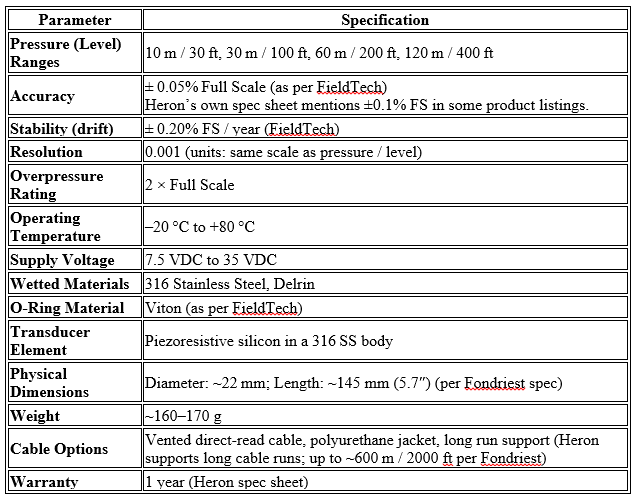
Application
The Pressure Transmitter is well-suited for:
- • Groundwater monitoring — wells, boreholes, aquifers
- • Tank level measurement — water tanks, storage, process vessels
- • River, stream, or open-channel monitoring for continuous water level tracking
- • SCADA / telemetry systems — integration into industrial control systems for remote monitoring or pump control.
- • Flood warning or water management — triggering alarms or pump shutdowns based on high or low level thresholds.
Benefits to Users
- • Real-time measurement: Continuous 4 20 mA output means you always know the water level, no waiting for log downloads.
- • High accuracy & stability: Low error (±0.05–0.1%) and low drift ensures dependable, repeatable measurements.
- • Wide environmental tolerance: Works across a broad temperature range and in harsh field conditions.
- • Easy integration: Compatible with SCADA, PLC, telemetry systems, or third-party loggers / displays.
- • Long cable runs: Current-loop output reduces signal degradation over long distances; vented cable allows barometric compensation.
- • Robust build: Stainless steel and quality O-rings make it reliable for long-term deployment.
Best Practices / Considerations
- • Use Vented Cable for Accuracy: If you want accurate water-level readings, use the vented cable option to compensate for atmospheric pressure changes.
- • Supply Voltage: Ensure your power supply is between 7.5 V and 35 V. Too low and the loop may not drive correctly; too high may damage the unit.
- • Wiring & Polarity: Use correct wiring; the transmitter is reverse-polarity protected, but correct wiring ensures reliability.
- • Install Securely: Mount the sensor so it remains stable and does not move or bounce around in water – movement may affect readings.
- • Protect the Cable: Long cable runs should be shielded or laid carefully to avoid damage; also, the vent tube must remain unobstructed for correct compensation.
- • Calibration / Zeroing: After installation, verify the zero (reference) point. For high-precision setups, perform periodic checks.
- • Maintain Regularly: Check for O-ring wear, seal integrity, and any signs of corrosion.
- • Overpressure Risk: Be cautious about exceeding the 2× overpressure rating during installation – it can damage the sensing element.



 CALL US
 WHATSAPP
 LOCATION