Chlorophyll Metre SPAD-502Plus
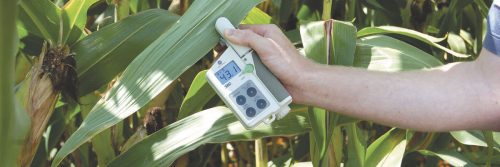
The SPAD 502Plus is a handheld, non destructive chlorophyll meter that enables rapid measurement of the chlorophyll content of plant leaves. By simply clamping the device’s measuring head onto a leaf, the meter provides a SPAD value that correlates to chlorophyll levels (and indirectly, the plant’s nitrogen status). This insight helps agronomists, farm managers and researchers optimize fertiliser usage, monitor plant health and enhance crop yield and quality.
Its compact, water resistant (IPX 4) form factor and extremely low power consumption make it well suited for field use across a wide variety of crops including wheat, rice, corn, cotton and more.
Key Feature
- • Quick, easy, non destructive measurement: clamp leaf between measuring head and get a SPAD value without cutting the leaf.
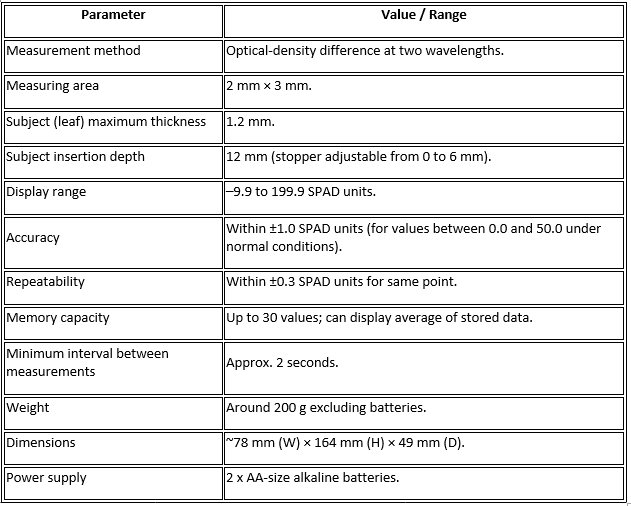
- • Trend graph display: device can store up to 30 measurements and display trends so that changes in chlorophyll values over time are visible.
- • Water resistant field use: IPX 4 rating allows outdoor operation even in rain (though not immersible).
- • Compact & lightweight: approx. 200 g (excluding batteries) and dimensions ~78 × 164 × 49 mm.
- • Low power consumption: uses LED light source; about 20,000 measurements possible with one set of two AA type alkaline batteries.
- • Small measuring area: 2 mm × 3 mm, allowing measurement on narrow or small leaves.
Technical Specification
Applications
- • Crop health monitoring: Assess chlorophyll levels in leaves which correlate with nitrogen status, plant vigor and photosynthetic capacity.
- • Nutrient management and fertiliser optimisation: Use SPAD readings to determine if additional nitrogen is required, thus avoiding over fertilisation and environmental leaching.
- • Research and agronomy: Field studies of leaf chlorophyll content across different crops, growth stages and treatments.
- • Precision agriculture: Integrate SPAD meter readings into agronomic decision systems for timely interventions.
User Benifits
- • Non destructive measurements allow repeated readings on same leaf through growth stages, enabling temporal trends.
- • Rapid measurements help in field scale surveys, saving time vs laboratory chlorophyll assays.
- • Portable and robust design for field suitability; helps agronomists and farmers directly in the field.
- • Facilitates improved crop quality and yield through more informed nutrient management and early detection of deficiencies.
- • Helps reduce input cost and environmental impact by optimizing fertiliser application.



 CALL US
 WHATSAPP
 LOCATION